 Phase 1 · Win 10 minutes
Make it feel like they have been here before
Pill 1.9 · Quick win · Give AI your material and let it distil your expertise
Read the full story
The scene
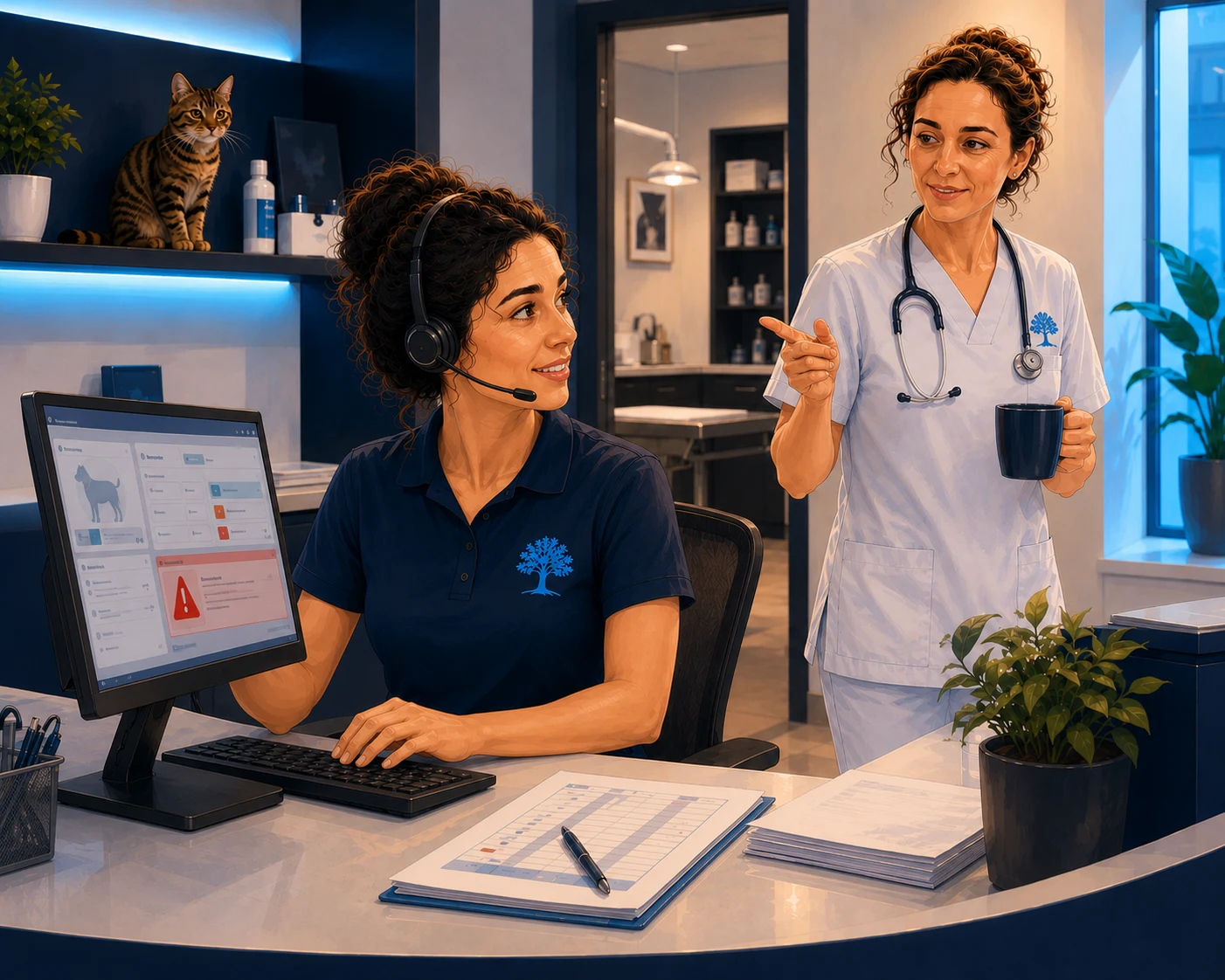
Wednesday, the first week of November, mid-morning. Two days have passed since the phone call. Sara called the Serranos back that afternoon, explained the blood test without making it sound like a sales pitch, and secured the one thing that stops a comparison: an appointment. There it is in the system: Thursday, 11:30, first appointment, female puppy, between Toby’s check-up and a vaccination. It is also on the task sheet she writes out every morning, so she does not have to keep going back to the computer a thousand times.
El Roble smells of coffee from the old coffee maker. Outside, it is already November; inside, the cyan of the Calle Olmos sign dominates the room at mid-morning. Roble keeps watch from the shelf, with that marked ear of his.
Mr Ramón comes in with Toby, without an appointment, to collect the usual drops. Sara opens his record: four details and an automatic red warning —‘CAUTION: may bite when his ear is handled’—. Someone added it years ago, and rightly so. But look at what the system lets them flag: five labels, always the same —‘aggressive’, ‘muzzle required’, ‘allergic’, ‘client in arrears’, ‘telephone unreachable’—, warnings that apply to everyone and no one. In eight years, that is the only ‘special’ thing the software knows about Toby: that he bites. There is no box for the fact that a treat calms him down.
Marta walks past with her coffee and, without slowing down, says to Mr Ramón:
—Would you like to give him the drops yourself, or would you prefer us to do it here?
Then, more quietly, to Sara as she passes:
—When he goes through, give Toby a treat before anyone looks at his ear, otherwise he gets stroppy. And don’t book him in at nine; he comes on the bus and arrives completely worn out.
And she carries on into the back. Sara nods and writes it down, because the software does not know those two things: Marta does, and she drops them into conversation like this, in passing, when needed. The record says that Toby bites; the treat, the bus, the fact that Mr Ramón needs everything in writing or he will ring three times… all of that lives in Marta’s head or —if you start digging— lies loose somewhere among Toby’s forty visits.
It is not that the software cannot store it. It can. There is somewhere to write it. What there is not is time: in the middle of checking a patient in, registering the pet with a full waiting room, no one stops to write that the dog relaxes with a treat. And once the consultation is over, they do not sit down to reread what happened and write it up neatly either. So the expertise stays where it was: in the memory of the person who was there.
The problem is that this memory is not always available. Hugo can sometimes come across as cold —not for lack of trying, but because he does not have Marta’s twenty years of experience in his head—. And when a locum comes in during August, they start from scratch with everyone. The treat, the bus, Lúa’s towel: every time, all over again, learnt through nasty surprises.
And Nube arrives on Thursday. A new family, still undecided. About whom they know absolutely nothing.
The nudge
Sara has been mulling it over for days, and with Nube’s appointment right there in front of her, it all comes together: what Marta knows but has not written down is precisely what makes El Roble different. It is not the price —they cannot beat the practice down the road, or anyone else, on that—; it is that here, when you walk in, someone knows your dog’s name and how to win them over. Either they record and share that knowledge, or it will always depend on Marta being on duty.
She thinks about how to give it shape, and sees two approaches. One looks ahead: create a short welcome questionnaire that the family can complete before the first appointment, which the team can then review and turn into useful notes. The other looks backwards: everything Marta has already written down over the years, buried in the patient records, which might perhaps be retrieved.
She starts with the first. She opens Gemini —what they use at El Roble— and simply asks it for a welcome form for a new patient. What comes back is correct and bland: a cold data form that could belong to anyone. It is missing things, and it sounds too much like a form. That is not it.
Then she remembers something Hugo said to her during a break, phone in hand: ‘Don’t explain to the machine what you want. Give it what you already have and let it read it.’ And it fits with what she was thinking: if Marta writes so much down, there must be gold in those records —little tricks, quirks, warnings— and probably recurring patterns too. What if, instead of describing the form to it, she gives it the patient records and lets the machine read them in full and identify what is worth asking? (Anonymised first, of course —with the owner’s details removed— because they are not needed to learn the pattern.)
While she is at it, two more things occur to her, although she knows they are neither for today nor entirely her responsibility: speak to Diego to see whether the software provider can export the patient records in bulk and transfer all that information into the files in one go; and, at the same time, prepare a place in the system itself to flag these things —their own real ones, not the same five labels as ever— so that they appear automatically, just as the ‘bites’ warning does. But that is a different kettle of fish —and someone else’s job—. Today, her task is the form.
The everyday task
It is not just Nube. It is every new patient who comes through the door.
The knowledge that sets El Roble apart has two drawbacks: it is scattered (loose across years of records, never in one place) and not shared (it lives in one person’s head). On the day Toby sees Hugo, or the August locum, or the client comes back on an afternoon when Marta is off, they start from scratch. For a young vet —or for reception— having that information in front of them is not a luxury: it is gold; it means walking in knowing what the experienced vet would know.
With a new client, the drawback doubles. That knowledge takes years to build… yet the time it is needed most is on the first day, when the family decides whether to stay with you or go to the practice down the road. The practice down the road may have an app and screens; what it does not have is someone who, at the first appointment, has already asked about what matters to you.
And let us be honest about what this does and does not do: with a puppy, the vet obtains most of the information through the clinical examination —there is no shortcut there—. This does not replace the appointment. It takes the registration burden away, retrieves the personal touch that is currently lost and ensures that whoever sees the patient goes in knowing a couple of things rather than going in blind.
The breakthrough
When you want AI to work with your judgement built in, there are two approaches that people confuse. One is to give it examples of what you want so it can copy them (‘here are three forms I like; make me another one just like them’). The other —today’s approach— is the reverse: give it your raw material, let it read it and distil it for you. You do not show it the result; you give it the raw material —your patient records— and ask it to extract the pattern itself. Three things turn this into a technique:
- Give it what you have; do not explain what you want. Listing in words what to ask during an initial intake is slow, and you always leave something out. It is easier to give it two or three records of patients you know and say, ‘read these and extract what helps us get to know them’. The material contains what you would not know how to list.
- It rereads what you do not have time to reread. This is where the gold lies. Those little details —Toby’s treat, Lúa’s towel— are not in any field: they are scattered across years of visits, not because the software cannot store them, but because there is never a spare minute to record them or read them again. The machine reads all forty visits, catches them and brings them together. Who rereads eight years of a patient’s history? It does, in ten seconds.
- With several cases, it extracts the pattern. Give it one and it tells you about that case; give it three —an older dog, a sensitive cat, a difficult bulldog— and you will see the same categories recur: safety, temperament, helpful tricks, what the owner is like. Those categories become the sections of your form, exactly as they are. It does not copy an example: it generalises from your cases.
And the limit —the red line— is this: AI distils what is already written; it does not invent your new patient. It is the family who say on the form that Nube is afraid of the hoover —the machine does not guess it, and if it does, it is making it up—. The vet must always validate the safety warning and the clinical information: you do not trust a box that says ‘this one bites’ without confirming it. And with a puppy, the information that truly determines what happens comes from the vet’s examination, not the form. AI reads what you do not have time to read and puts it in order for you; you provide the editing, the judgement and the final sign-off.
 10:18
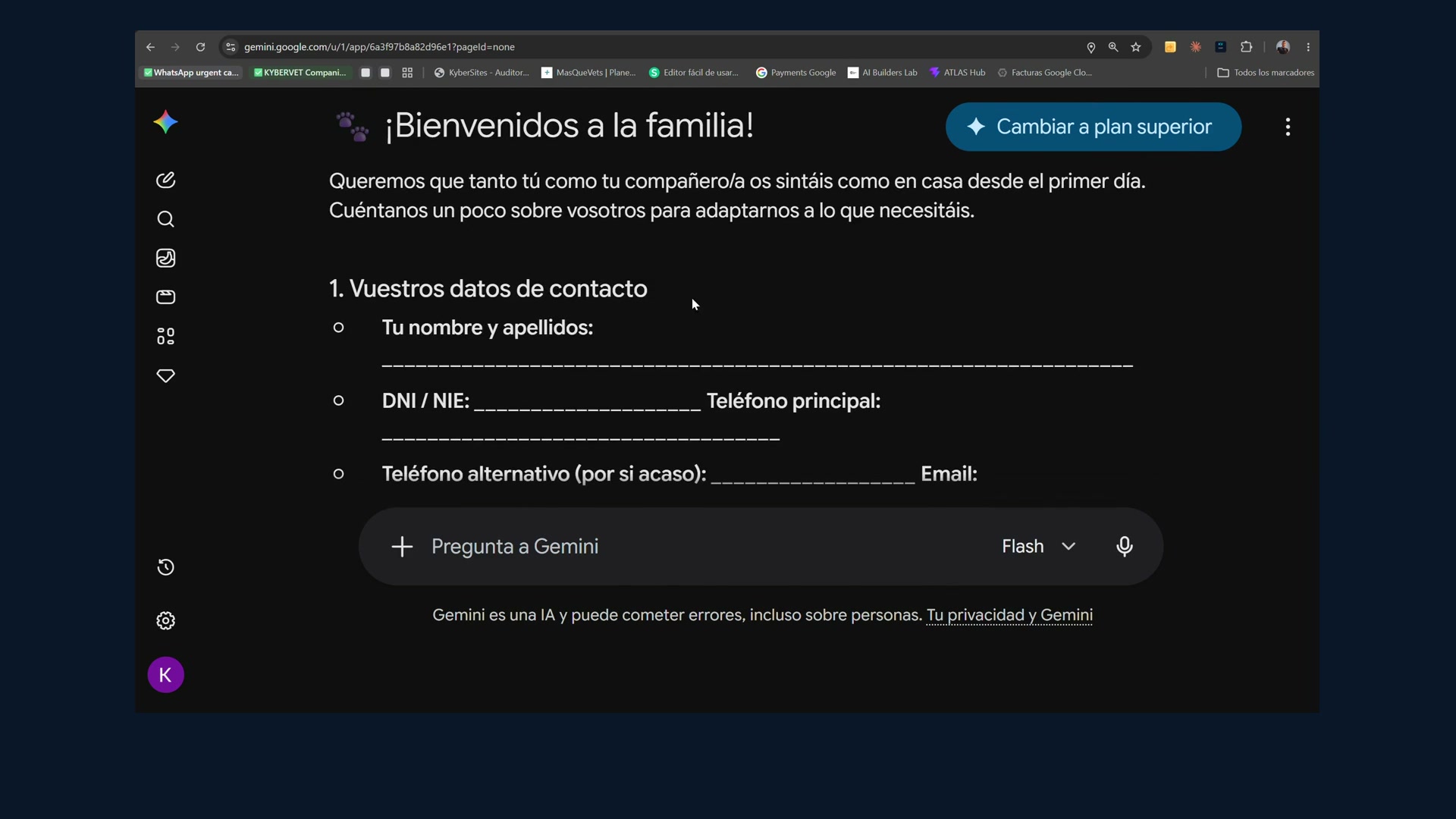
10:18Recorded live in Gemini. First, the form requested with no further context: correct and generic, suitable for any practice. Then we give it three records from long-standing patients —exported from the practice-management system and anonymised— and ask it to read them and extract what is not captured in any field: it produces an analysis of what it has picked up (the brachycephalic dog that becomes distressed, Toby’s ears, the metal scales, the towel from home, owners who need information in writing…) and uses that to build a one-page welcome form. Finally, it turns the form into a Word document ready to edit and print, and closes with the practice rule: do not use it as-is —make it yours, using your own records— and, better still, send it to the family so they bring it completed before the appointment.
The form in action
This was produced in Gemini, which is what they use at El Roble, in two steps. (Using the free version, and the output is slightly different each time: it is a draft to adjust, not a verdict.)
With no context. She simply asked it for ‘a welcome form for a new patient’. And the expected result appeared: a correct, cold data form —name, national ID number, phone number, pet’s details, reason for the visit, data protection, signature—. Useful for registration, silent on everything else. It could belong to anyone.
With the three regulars. She then gave it the records of Toby, Lúa and Káiser —anonymised— and asked it to read them in full, extract what helps the team get to know the animal and their family, and use that to build the form (using the earlier contact details and consent as a base). Before producing the form, Gemini showed what it had picked up between the lines:
That some reactions are not aggression, but distress (a brachycephalic dog becoming breathless) or pain in a particular area (the ears). That some animals become nervous on the metal scales and are better weighed on a mat. That certain cats need to be taken straight into the consultation room. That a towel from home, smelling of home, calms anxious animals. That a treat or a piece of bread can distract them before handling. That some owners need things in writing, in large print or with specific figures —while others appreciate the detail—. That some owners have limitations (sight, dexterity, hearing) that make giving medication at home difficult. And that some families respond badly to ‘lectures’ and cooperate much better when given facts.
No one told it any of that. It was scattered across years of visits that nobody rereads, and it brought everything together in ten seconds. From that pattern, it built a form containing the sections no template includes: what the animal is like and how to handle them, the tricks that win them over, and how to work with the family —as well as the usual details and consent—.
And then the adjustment, which Gemini does not make. The form was excellent… and just a little too much: six sections, a few form-like headings, a long consent statement. Marta does her part: cuts it down to one side, writes it in plain language and in El Roble’s own voice; makes sure the safety section genuinely asks what they need to know —‘what do we need to be careful about?’—; and remembers the obvious: the machine knows nothing about Nube; the family will provide that information. AI extracted the template from years of records; the practice’s form is signed off by the vet.
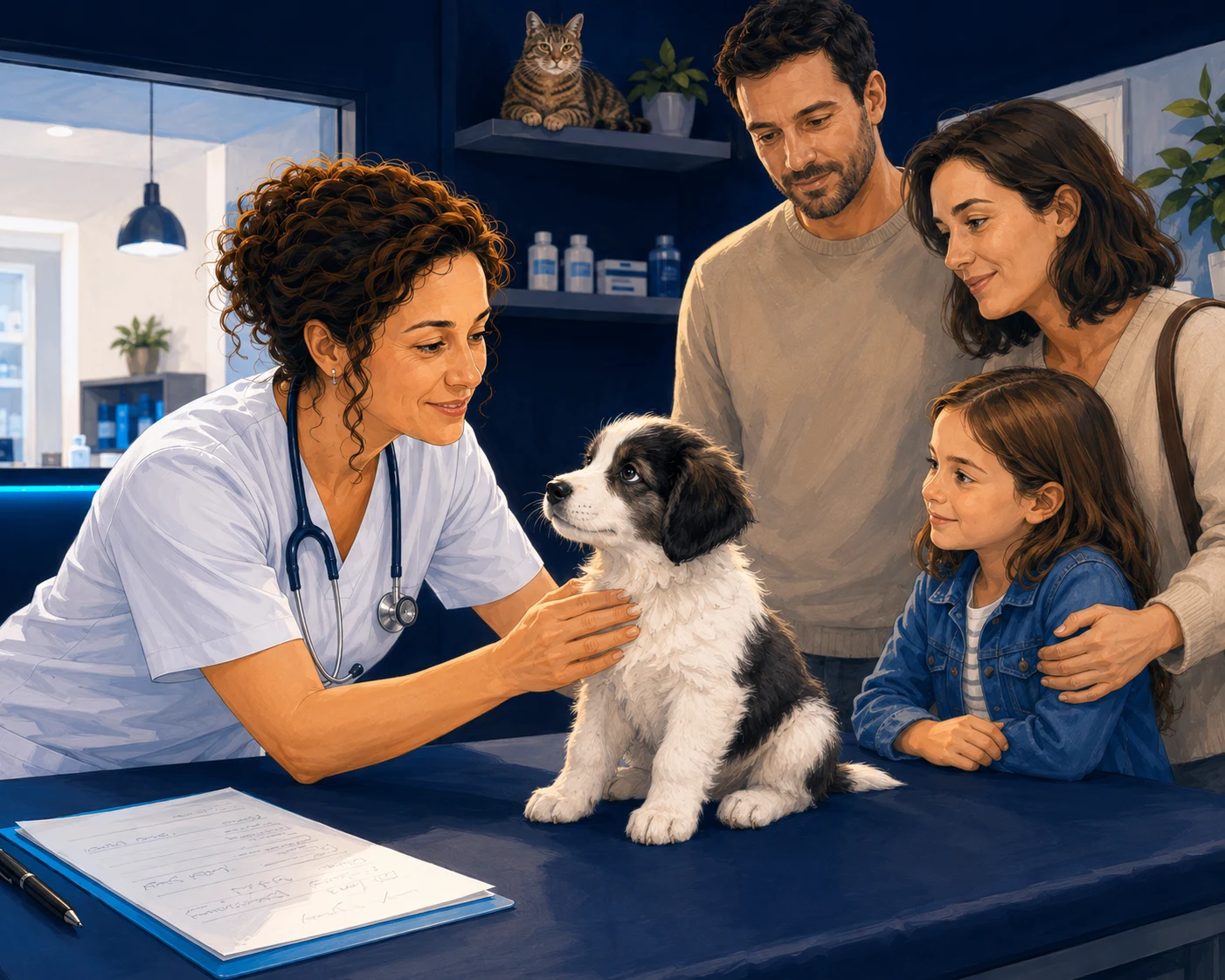
And on Thursday, when the Serranos came in, they brought the completed form with the little they knew —they had only had Nube for a few days: she came from a rescue centre, hid when the hoover was on and simply would not eat dry food—. Marta did not begin with an interrogation: she crouched down to the puppy’s level and, looking at her, mentioned what she had read. The Serranos looked at each other, more relaxed. It was not magic —they had written it themselves—: someone had asked, and someone had read it. The practice down the road, with its €23 plan, had not asked them anything.
Do it yourself in 4 steps
- Gather two or three good ones. Records of patients you know inside out —ideally varied: an older dog, a cat, a difficult case—. And anonymise them first: remove the owner’s name, national ID number, phone number and address; the clinical text and notes are enough.
- Give them to it and have it read them. In a new chat, attach them and ask: ‘Read these records in full and extract everything that helps us get to know and handle the animal and their family better and that is not in any field. Use that to create a one-page welcome form for a new patient, containing only questions to collect information.’ Do not explain the format: let it derive it from the material.
- First, look at what it has caught. Before the form, let it list what it has picked up between the lines: you can see at a glance whether it has understood your patients. Then comes the form, with its sections.
- Then add your part, which cannot be delegated. Cut it down to one side and adapt it to your tone, strengthen the safety section, and have the vet validate it. Remember: the family provides the new patient’s details when completing the form, not the machine.
Sara’s tip: save the form and keep adding to it. Whenever a vet says from memory, ‘oh, be careful with this one because…’, write it down. In a month, you will have on paper what currently lives in one person’s head.
The prompt · copy it
CONTEXT
I am giving you the full records of two or three long-standing patients from my veterinary practice (attached and anonymised). Read them IN FULL and extract anything that helps us get to know and treat the animal and their family better and is not captured in any field: temperament, safety and handling, fears, helpful tricks and preferences, and the owner’s personality or circumstances.

TASK
Using that, create a one-page WELCOME FORM for a NEW patient, containing only questions to collect information (no diagnoses or treatment instructions). Use the usual contact details and consent as a base.

LANGUAGE AND TONE
Warm and human, like a person speaking at the reception desk of a local practice. Avoid the language of forms and surveys. Include who the animal lives with (other animals, children) and what the family expects from or is worried about regarding this first appointment. Use British English.
Before → Now
Before. What makes a client special lives in the experienced vet’s head or is scattered across years of notes that nobody rereads. If that person is not there, everyone starts from scratch —and getting to know a new patient takes years, even though the first day is precisely when you know the least about them—.
Now. Five minutes: you give AI two or three of your best patient records and it distils the welcome form that asks what your experienced vet would ask. The family completes it, whoever sees them reviews it, and you walk in informed. The best thing is not the form: it is that the expertise no longer lives in just one person’s head, and from the first minute the client notices that people here ask about what matters to them.
Before you begin
- AI extracts the template; you provide the expertise. It distils a form from your patient records that asks the right questions. What is asked, what relates to safety and what is clinical are decisions for the vet.
- It does not guess who your patient is, and it does not replace the examination. The family provides the details about a new animal; and with a puppy, the vet obtains most of the information by examining them.
- Anonymise what you give it. If you use real patient records to teach it the pattern, first remove the owner’s details (name, national ID number, address, phone number). It does not need to know who owns the animal to learn your way of getting to know a patient.
- Safety is confirmed, not delegated. A ‘may bite’ warning must be validated by whoever sees the patient; a box is not a guarantee.
- Works on free plans (subject to a daily limit). Requires an internet connection.
Practice materials
Three fictional, anonymised records and the editable intake sheet created during the demonstration.
Three fictional, anonymised records and the editable intake sheet created during the demonstration.
Three fictional, anonymised records and the editable intake sheet created during the demonstration.
Three fictional, anonymised records and the editable intake sheet created during the demonstration.
Video transcript
So, we're back at El Roble. Today I want you to see the difference between writing a good prompt and also using AI's capabilities to get more from it and analyse information, as we have done before. Normally, Sara wants to create a welcome form for a new patient. She could ask: “Create a welcome form for a new patient at my veterinary clinic.” We would get a fairly generic answer asking for details, the pet's details, medical history, diet, background, data protection... It is a good starting point, but very generic. It could be used at any clinic, with no distinctive features. The idea is to go a little further. We are going to give it three reports taken from clinical records. Here is one. We have tried to anonymise them. Remember, you can redact the data in the PDF or use other methods. These are clinical records of patients who, as you saw in the story, have spent years at the clinic and had several appointments. You can export them from your systems. Once we have them, we provide them all: we bring them in and paste them here. We will give much more detailed instructions about what we want. Remember: the key is to specify everything we need very clearly. We enter a prompt here—the one in the lesson—and see how it goes. I say: “Here are the full records of three long-standing patients at my veterinary clinic. Read them fully and extract anything that helps us know and treat the animal and family better, but is not covered by a standard field: temperament, safety and handling, fears, tricks and preferences, personality or the owner's circumstances. Create a one-page welcome form containing only questions to collect information—no diagnoses or guidance.” Add: “Use what you generated earlier as a basis for contact details and data protection.” As always, we define the tone, which is important: warm and human, like someone speaking at a neighbourhood clinic. No form-like, survey-like or technical wording. Use straightforward, plain questions. Add who they live with—other animals or children—and what the family expects or worries about at this first visit. Use European Spanish. It will read records that could be far longer and more complex. Here is the answer. Let's see what it says. It says: “Useful information extracted from the records. After analysing Káiser, Lúa and Toby's clinical files, recurring patterns were identified in handling, behaviour and family dynamics, outside the standard medical fields, which are key to optimal care. Temperament, safety and handling in consultations. Reactions to stress or pain. Some animals do not react out of aggression, but from breathing distress, as in brachycephalic breeds like Káiser, or pain in sensitive areas, such as Toby's ears. Surfaces and surroundings: some become nervous on slippery surfaces, such as metal scales, and should be weighed on a mat. Some cats need to go straight into the consulting room instead of waiting with dogs. Familiar-smelling items, such as towels or blankets from home, help with handling.” It also covers tricks, rewards, adjustment time, temperament, family circumstances and tailored communication: some guardians need information in writing; others need measurable targets, such as charts, to understand and help. It also notes physical or technical limits, schedules and dislike of lectures. You experience all this in your day-to-day work and get to know clients and adapt, but since each person sees clients at different visits, experienced staff know them better, while less experienced staff find it harder. Some clients are also more difficult. Being able to review all this quickly would be very useful. Sara suggests a welcome form so that, from the very first day, we can have this information and keep adding to it. We can also customise the alerts in the management system, because every clinic has its priorities and what creates value for it. Here, AI has produced a prototype welcome form for a new patient, trying, as requested, to make it warm and fit on one page. You can now decide how you want to manage it. It includes welcome and family, contact details and “Meet your companion”: their name, species and breed... The usual details, but in a more natural style. It asks about daily life, who they live with and offers space for notes; also, how they cope with leaving home or visiting the vet, and any tricks or preferences. It includes what helps them feel comfortable and similar questions. Ultimately, it provides a more personalised form, which is what Sara wanted. You can take a different approach or use it in another way. The idea is to provide data and plenty of context—here, clinical cases with your notes. It can then help ask what makes the patient comfortable, how we can help today and about data protection. It is a more personalised form. You can keep interacting with it and improving it. You can copy and paste this content into Word, or ask it directly to create it, if the free version allows. For example: “Put this form in a Docs document, ready to edit and print.” Let's see if it can. It will probably take a little longer. And look: it has created a well-formatted document that we can use or personalise with our logo. There are a few small errors with the emojis, but the form is ready and we could replace or change anything we wanted. It saves time and we can use it. I hope you find it useful. In the document, I encourage you to create your own versions using the examples. You can experiment with them or use your own records—in other words, put it into practice. The aim is not to use this document as-is, but to make direct use of AI for your own situation and personalise it. I would also recommend that, although these forms are useful, you can ultimately send them for clients to bring completed or fill in before their appointment. It is always better to do this in advance, so the vet has the information in the system before the patient enters the consulting room. It would also be useful to store this information in your management system in a customised way. For that, you need to work with your suppliers and make use of the alerts, notes and powerful features that these systems offer. See you next week.