I will be direct.
I see three types of veterinarians right now regarding artificial intelligence.
Those who haven’t touched it. No ChatGPT, nothing. They keep doing everything like in 2019 and expect the world to wait for them. I have already dedicated other posts to them. If you are in that group: start. Open a chat, ask it to draft an email, summarize an article, help you organize an idea. It’s free. It’s the first step. And without that step, everything that comes after does not exist for you. But don’t just stay exploring: get some training, even if it’s basic. Learning to use a chat well already makes the difference between wasting time and gaining hours every week.
Those who already use it and know how to take advantage of it. They ask it questions. It helps them write, summarize, find information. They gain time and probably quality in some tasks. It’s a great step and the right path, congratulations. But don’t stay there, “using AI” is not just having a conversation with a chat. You are using a Formula 1 to go buy bread. The worst part: they don’t know it.
And then there is a third group. Small. Very small still. Those who have understood that the chat is only the gateway. That what lies on the other side is infinitely larger. That today they can build things that two years ago required a programmer. These professionals are hurting from something else: time. They know what’s possible, but their day-to-day doesn’t let them develop it. And here is some good news: if you know what can be done, you can ask someone to do it for you while you dedicate yourself to your patients.
This article is focused mainly on those in the second group. For them to take the leap to the third. But if you are from the first, so you see where things are headed. And if you are from the third, to remind you that you don’t have to do it all alone.

The conversation is just the gateway
When most professionals — veterinarians included — think about AI, they think about a chat. A window where you write a question and receive an answer. Sometimes good, sometimes regular, sometimes impressive.
And they stay there.
But what has happened in recent months — and when I say months, I mean literally months, not years — has changed the rules of the game in a way that most have not yet processed.
Today you can not only converse with an AI. You can build with it.
Tools. Workflows. Automations. Small applications that solve very specific problems of your day-to-day. Things that a year ago required a programmer. Two years ago, a development team. Five years ago, they weren’t even conceivable for someone without technical training.
And now they are within reach of anyone who dedicates a few hours to understand how they work.
I’m not talking about science fiction. I’m not talking about Silicon Valley startups. I’m talking about a veterinarian in their clinic, with their computer, on a Saturday morning, building something that will save them hours every week.
The circle that traps you
But there is a problem. And it’s a problem that feeds itself.
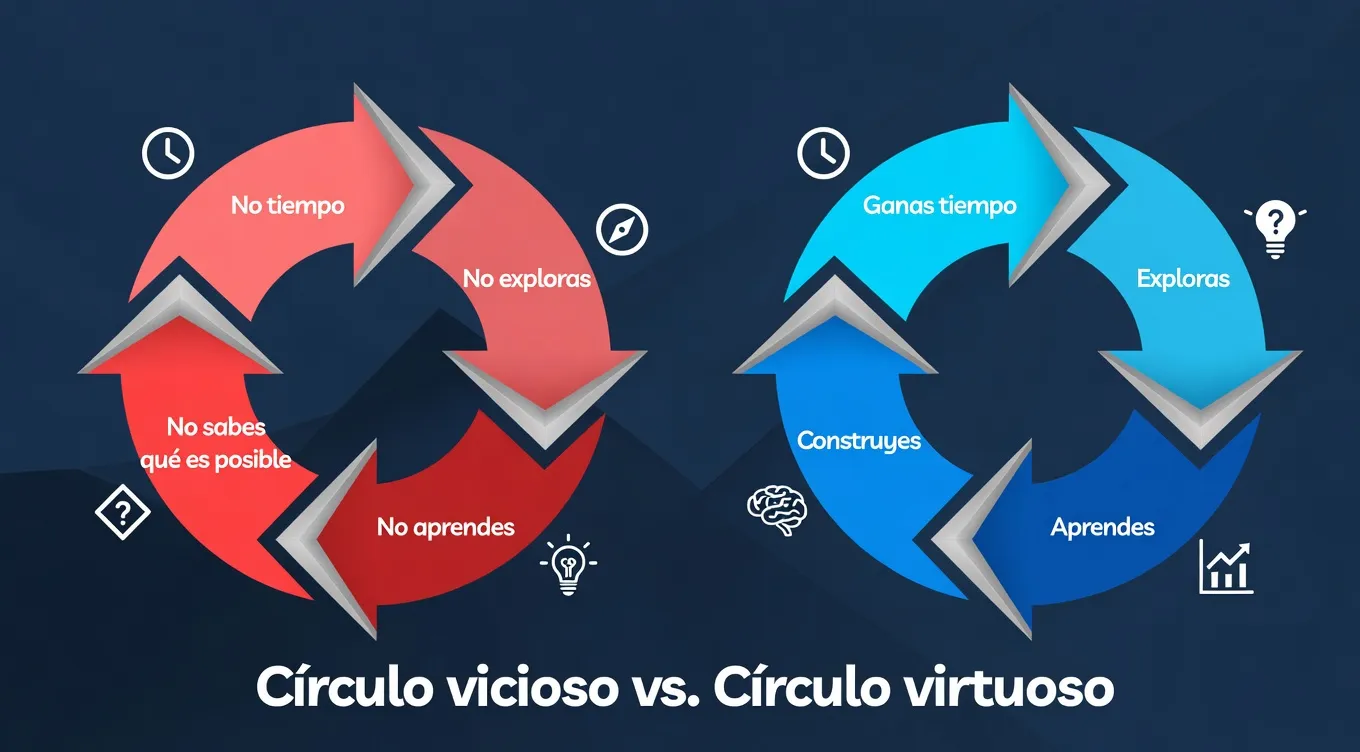
You don’t have time.
Because you don’t have time, you don’t explore. Because you don’t explore, you don’t learn. Because you don’t learn, you don’t discover what’s possible. Because you don’t discover what’s possible, you keep doing everything exactly the same. And you still don’t have time.
It is a vicious cycle. A vicious circle that repeats week after week, month after month. And each month that passes, the distance between what you could be doing and what you actually do becomes greater.
This is not exclusive to veterinary medicine, obviously. But in our sector, it has a special component.
Veterinarians have always been curious about technology. They like devices. They have invested in equipment, diagnostic imaging, lab devices, surgery tools. But that was technology that you buy, plug in, and it works. Something you see, touch, that has a power button.
What is happening now is different. It is not a device. It is not software you install. It is infrastructure. Something closer to electricity than an ultrasound machine: a foundational layer upon which everything else will be built. This is not bought from a catalog nor presented at a congress with a pretty stand. And that creates a barrier that many do not know how to cross.
That requires something else. It requires sitting down, exploring, understanding. Stepping out of your comfort zone. And that is where most stop. Not for lack of interest, but because the first step is not as obvious as opening a box and plugging something in.
What it really means to “build” with AI
I will give concrete examples, because otherwise, this sounds like a conference talk.
Imagine that in your clinic you have a recurring problem: owners call to ask for results, appointments, schedules, the status of their pet after a surgery. Your team loses fifteen minutes on the phone on each call. Multiply that by five or ten calls a day. Those are hours invested in something that could be solved differently.
With the tools available today, you could create a workflow that, when a process is ready, automatically sends a notification to the owner by email or WhatsApp with the information they need. Without anyone picking up a phone. Without anyone drafting a message. The team intervenes only when a real conversation is needed.
Is it complex? Not as much as you think. Does it require knowing how to program? Less and less. Does it require understanding what tools exist and how to connect them? Yes. And therein lies the key.
Another example. Your website. That one you updated three years ago and since then is basically a digital brochure. It’s there, it exists, but it does nothing for you. Today you can turn that website into an active channel: that allows requesting appointments, answers frequent questions, captures information from new clients, communicates automatically. And you don’t need to wait for an agency to do it or depend on a third party every time you want to change something. The tools to add that functionality are available and work with natural language.
Your website stops being a showcase and starts working for you.
And another one. Your management software does not do exactly what you need. It never has. You’ve spent years asking for features that don’t arrive, adapting to a system that was designed for the lowest common denominator, not for your way of working. What if you could build small tools that complement what your software doesn’t cover? A smart form for telephone triage. An automated post-surgical follow-up system. A dashboard that shows you exactly the indicators you want to see, not the ones someone else decided were important.
All of that is possible today. Not tomorrow. Not “when the technology matures”. Today.
The illusion of the all-in-one software
Here is an important nuance that many professionals don’t see.
The natural reaction to all this is to think: “Sure, but my management software will eventually incorporate AI and do it for me.”
And maybe yes. Some will. In fact, they are already starting.
But there are three problems with that waiting strategy.
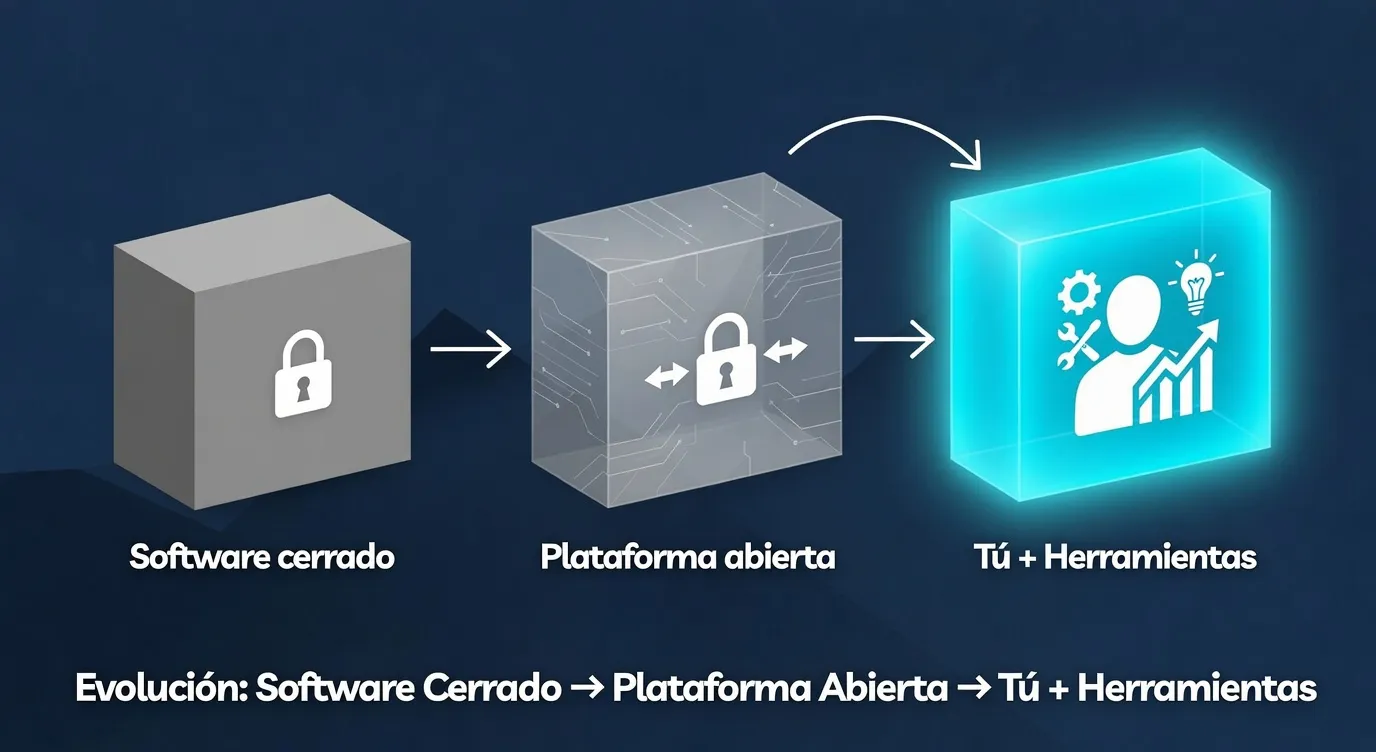
First: the model. Veterinary management software was built with a development mindset that belongs to another era. They are rigid structures of processes. Closed workflows. Features added one by one, release by release. They could go faster — AI itself allows them to develop at another speed — but the problem is not pace, it is conception. To really take advantage of what AI offers, these companies would have to evolve from a closed software to an open platform: an environment where you can build custom solutions or integrate specialized tools for each process. And that change in mindset is not solved by putting a chatbot in the interface.
Second: generic nature. When your software incorporates AI, it will do so generically. The same feature for everyone. The same workflow for a neighborhood clinic with two vets as for a referral hospital with twenty. The same report. The same process. Because that’s how market software works: it is designed for the maximum number of users possible, not for you.
Third: dependency. Every feature you delegate to your software is a feature you don’t control. You don’t decide when it arrives, how it works, or how much it costs. You are at the mercy of a third party’s roadmap. And that, in an environment changing at this speed, is a risk.
I am not saying management software won’t evolve. I am saying the future probably isn’t a software that does everything, but platforms that allow integrating, building, and customizing. And to take advantage of that, you need to understand what is possible.
We return to the same point.
The other circle: the one that frees you
There is a moment — and I have seen it happen — when someone breaks the cycle. They invest a weekend. A few hours. They sit down, explore, start to understand what tools exist, what they can do, how they connect to each other.
And something changes.
It’s not that they suddenly become a programmer. It’s not that they stop being a veterinarian. It’s that they start seeing possibilities where before they only saw limitations.
They build a first small thing. A simple automation. A workflow that saves them twenty minutes a day. And those twenty minutes become mental space to think about the next improvement. And the next. And the next.
It is the virtuous circle: you learn → you build → you gain time → you reinvest that time into learning more → you build more.
And the most interesting thing is that you don’t need to do it all yourself. Once you understand what is possible, you can make informed decisions. You can ask for help with good judgment. You can design solutions even if someone else implements them.
But for that, the first step is to know what exists. Because the one who knows, decides. The one who doesn’t, waits.
The time factor: the central paradox
I know what you are thinking. “All this sounds very good, but I don’t have time.”
I know. Believe me, I know.
But think about this: every hour you invest in understanding these tools has the potential to give you back dozens of hours over the year. It is not an expenditure of time. It is an investment with a return.
The problem is the return is not immediate. It’s not like buying new equipment you didn’t have, plugging it in, and the next day you are billing new services with it. The return is progressive, cumulative and, at first, difficult to measure.
And that is why most do not take the step.
Because the urgent always beats the important. Because today you have consultations, tomorrow you have surgeries, the day after you are on call. And next week the same. And the next.
But there is a moment when you have to pause and ask yourself: am I going to keep doing exactly the same thing in five years? Am I going to keep complaining that I don’t have time while everything around changes?
Or am I going to invest a few hours in opening that toolbox that has been waiting in the corner for months.
It is not about technology. It’s about decision-making capacity.
If I’ve learned anything in more than twenty years working with veterinarians and technology, it is that the problem has usually not been a lack of interest. The problem has been a lack of context.
When a veterinarian understands what a tool can do, they decide. It’s true that for many change is hard, that taking risks is not comfortable. But when they see the value and more colleagues adopt it, they act. It has always been this way.
With AI something different is happening: they don’t see the value because they don’t see the tool. They only see a chat. And the chat, by itself, transforms nothing. The one that transforms everything is you using it as a tool, deploying its power.
What transforms is understanding that you have the capacity to build. To automate. To create custom solutions tailored for the specific problems of your clinic, your team, your way of working.
And that does not require being an engineer. It requires curiosity, a few hours, and a clear guide.
One last thought
The brightest veterinarians I know — those who built the best clinics, who innovated, who were ahead of the curve — many of them sold their businesses to corporate groups in recent years. They sought relief. Less management, more medicine. And it is understandable.
But a part of what was drowning them — the management, the administration, the repetitive processes, the non-clinical burden that consumes the day — today has solutions that didn’t exist then.
If there’s anything I want you to take away from this article, it’s three ideas:
- Start. If you don’t use AI, start. And train yourself to use it well. Learning to work with a chat efficiently is already a before and after. But it is only the foundation.
- Don’t stay there. The chat is the gateway because everything works with natural language. But what lies behind is exponentially larger. Automations, workflows, custom tools. Open your mind and explore beyond the conversation.
- If you don’t have time to build it yourself, that’s fine. There are people dedicated to that. But if you don’t know what is possible, you won’t identify the opportunities. And you will fall back into generic, standard solutions that are not designed for you.
The question is not whether AI is going to change veterinary medicine. It’s already changing it.
The question is whether you are going to be one of those who mould it to their measure or those who wait for someone to give it to them ready-made.
Opening the box doesn’t cost that much. What costs is continuing without opening it.