It is Monday at eight in the morning. You arrive at the clinic, turn on the computer, and while the management software boots up, you open Instagram almost out of habit. The photo of the kitten you operated on last week has 47 likes. The video of the puppy recovering from parvo has reached 120. The comments are a shower of hearts and starry-eyed faces. For a brief moment, you feel good. All that content work is paying off.
But then you look at the day’s schedule. Two gaps. Three if you count the appointment that just canceled via WhatsApp.
And you ask yourself the question that almost no one dares to say out loud: how many of those 47 likes have turned into appointments this week? How many of those followers are real clients who actually step foot in your clinic? How many of those hearts pay bills?
The answer, in most cases, is disheartening. And not because social networks are useless. It’s because we’re using them for something they aren’t designed to do.
The misunderstanding: confusing the waiting room with the consultation room
There is a widespread misunderstanding in the veterinary sector about the role social media plays in client acquisition. It is understandable: when you see your followers grow, when posts generate interaction, when comments are positive, the feeling that you are doing something right is immediate and rewarding. And you are doing it right. But for a different purpose than you probably think.
Social networks are your clinic’s waiting room. A space where people who already know you, who have already visited at least once, who already trust you, can stay connected with you between visits. It is where you build loyalty with the ones you already have. It is where you strengthen the relationship with existing clients. It is where you show your human side, your day-to-day, your team, your success stories.
But the waiting room is not where the sale is closed. It is not where the client decides to trust you for the first time. It is not where the pet owner who just moved to your neighborhood and is searching for “vet in Vallecas” is going to find you.
Think about it for a moment. How does someone who is new to a city look for a vet? Someone whose dog just got sick and their usual vet is on vacation? Someone who needs emergency care at ten at night? They don’t open Instagram to see if a clinic randomly pops up in their feed. They don’t search hashtags hoping to find something relevant.
That owner opens Google. They type “vet near me”. And they expect results.
And if you are not there, if your website does not appear, if it appears but fails to convince, if the owner reaches a page that looks like it’s from 2012 with a phone number nobody answers, that client goes to the next result. To the one that does have a professional website. To the one that appears on Google Maps with recent reviews. To the one that allows them to request an appointment without having to call.
While you keep accumulating likes.
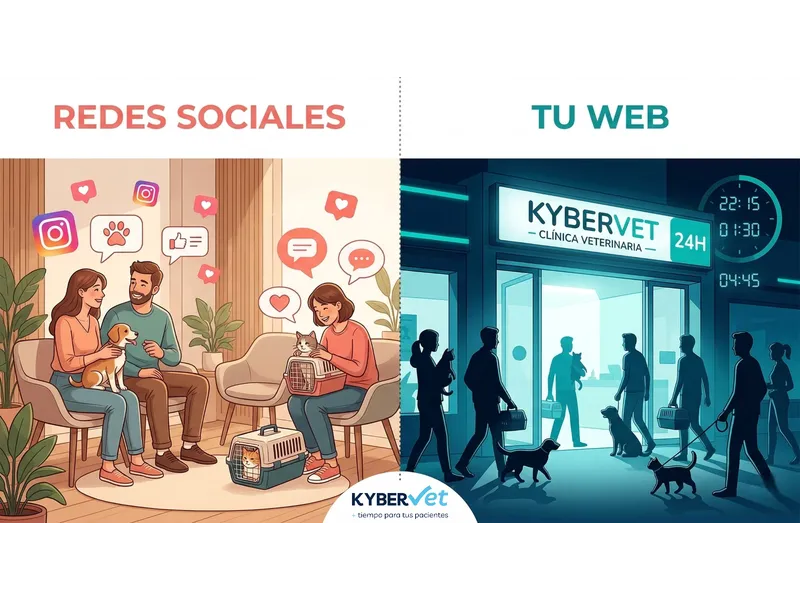
Social networks are your emotional connection with those who already know you. Your website is your storefront for those who have not yet discovered you. Confusing the two is the most expensive mistake you can make.
The flow that works: first the website, then everything else
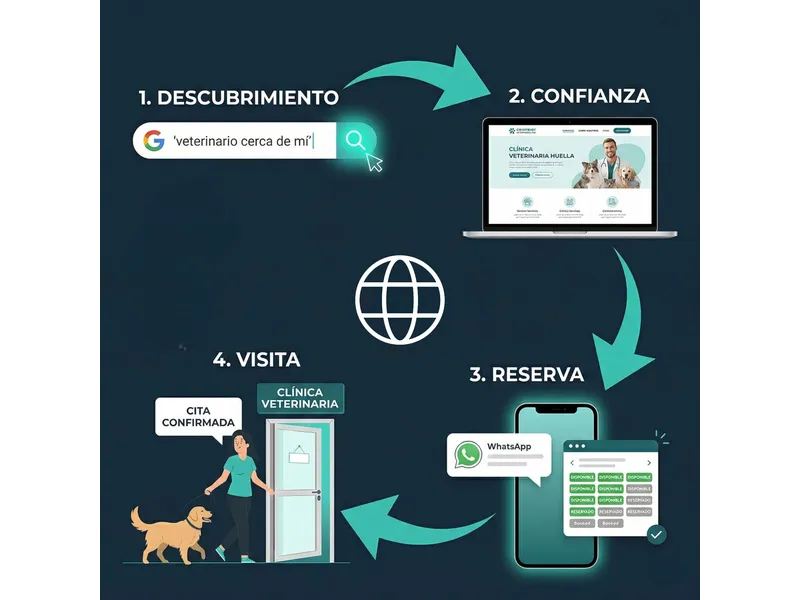
Let me describe how the process of acquiring a new client actually works in 2026. Not how it should work in an ideal world, but how it actually works in the mind of the pet owner looking for a vet.
Step 1: They find you. The owner searches on Google. They type something like “vet near me”, “veterinary clinic [neighborhood name]”, “emergency vet [city]”. Google shows them results. If your website is well-positioned, you appear. If you’ve worked on your local SEO and your Google Business listing, you appear on the map with your address, hours, and reviews. If you haven’t done any of this, you don’t exist. It’s that simple.
Step 2: They stay. The owner clicks on your website. In less than three seconds, they decide whether they trust you or not. The website loads fast or it doesn’t. It looks professional or it looks abandoned. The services are clear or they have to hunt for them. The hours are visible or they are a mystery. There are real client reviews or just self-promotion. In those three seconds, the owner has decided whether to keep exploring or go back to Google to find another option.
Step 3: They commit without calling. This is the key that many clinics do not understand. Today’s client does not want to call. Calling implies waiting for someone to pick up, explaining their case, coordinating schedules, relying on reception not being saturated. Today’s client wants to solve their need right then, without friction, without waiting.
A well-designed website allows them to do so. They can book an appointment online picking the day and time. They can send a proactive WhatsApp from a button that asks “Can I help you?”. They can check services and prices without asking. They can read answers to frequently asked questions. They can view reviews from other clients and convince themselves.
Each of those actions is a micro-commitment that brings them closer to conversion. Every click makes it harder for them to leave. And it all happens without you having to do anything at all.
Step 4: The double win. This is what makes a good website so profitable. You have acquired a new client without them having to call. And you haven’t wasted time on the phone answering questions that the website already addresses.
In a previous article we talked about the real cost of unanswered calls: the clients who leave, the opportunities that are lost. But there is an even more interesting question: what if many of those calls were never necessary in the first place?
A website that works doesn’t just acquire clients. It filters out trivial inquiries. It answers recurring doubts. It frees up your team so they can focus on what really matters: in-person care for the client and the patient. It is passive acquisition plus operational time savings. It is the clearest return on investment you can find.
Think about all those calls you receive every day asking for opening hours. Or if you vaccinate cats. Or how much a consultation costs. Each of those calls interrupts whoever answers it, consumes time and, often, doesn’t even result in an appointment. A well-designed website answers all those questions before anyone has to pick up the phone. The client who finally calls or requests an appointment already knows what they need to know. They are already convinced. They just need to confirm.
Social networks are not the enemy: every tool in its place
I don’t want this article to be misinterpreted as an attack on social media. It isn’t. Social networks have massive value for a veterinary clinic, but it’s a different value from what many believe.
Networks are your emotional storefront. They are where you show that behind your clinic are people, not just professionals. They are where you share the day-to-day, the small victories, the cases that turn out well, the team that makes it all possible. They are where clients who already love you can continue to feel connected to you even if they don’t have to visit for months.
That has incalculable value for loyalty. A client who follows you on Instagram and sees your posts regularly keeps you top of mind. When they need something related to their pet, they will think of you before anyone else. And when someone asks them for a vet recommendation, they will recommend you.
But there is a fundamental difference between loyalty and acquisition. Networks build loyalty with those who already know you. They do not capture those who don’t know you exist.
And there is another problem that many ignore: the algorithm. When you post on Instagram, Facebook, or TikTok, you don’t decide who sees your content. The platform decides. And the platform has its own interests, which do not always align with yours. You can have 5,000 followers and your post might only be seen by 200. You can put effort into creating quality content and the algorithm might decide to bury it because that day it doesn’t fit what the platform wants to promote.
Your website is different. Your website is 100% yours. Nobody decides who sees it except Google, and with Google, you can work on positioning systematically and predictably. Your website works 24 hours a day, 7 days a week. It doesn’t have bad days. It doesn’t depend on the mood of any algorithm. It doesn’t force you to constanly create content just to maintain visibility.
Networks are a tenant who can leave whenever they want. Your website is a property that belongs to you.
Furthermore, there is something that is rarely mentioned: the time social media consumes. Creating quality content for Instagram takes hours every week. Replying to comments, interacting with followers, keeping an eye on trends. It is a constant job that, if you abandon it, is noticed immediately. Your reach drops. Your engagement falls. It’s like a hamster wheel you can’t step off of.
The website, on the other hand, is a one-time investment with continuous benefits. You design it well once, you update it when necessary, and the rest of the time it works on its own. It doesn’t demand daily attention. It doesn’t penalize you if you have an intense surgery week and can’t publish anything.
If you only had to choose one thing for your digital strategy, choose the website. Networks are the complement. The website is the foundation.
What your website should do for you (and probably doesn’t)
At this point, the logical question is: how do I know if my website is working or just taking up space on the Internet?
There is a series of functions that a modern veterinary website should fulfill. They are not extras or luxuries. They are the bare minimum to compete in 2026. Review them and be honest with yourself about how many your current website meets.
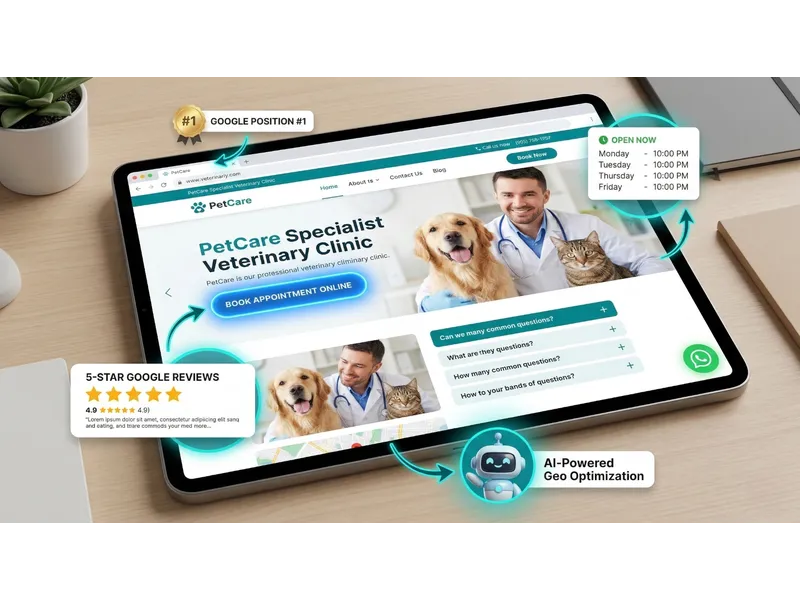
To appear on Google when they search for “veterinarian + your city”. If you type your specialty and your area into Google and you don’t appear on the first page, your website does not exist for the potential client. Local SEO is not optional. It is the first survival filter.
To display services and hours without anyone asking. Basic information needs to be visible in five seconds. What you do, when you do it, where you are. If the visitor has to search for this, they will probably leave before finding it.
To allow booking an appointment without calling. An online booking form, an integrated scheduling system, a working WhatsApp button. Today’s client expects to be able to book when it’s convenient for them, not when your reception is available.
To have proactive WhatsApp. Not a hidden link on the contact page. A visible floating button that invites conversation. “Have doubts? Write to us.” That first contact via WhatsApp might be the start of a years-long relationship.
To show real reviews that build trust. Google reviews, testimonials from satisfied clients. Social proof is the most powerful deciding factor after price. If your site doesn’t show that others trust you, the new visitor has no reason to do so.
To answer frequently asked questions. Every time someone calls to ask for the opening hours, the price of a vaccine, or whether you treat exotics, it’s a call that could have been avoided. A good FAQ section frees up your team and educates the client before they arrive.
To be ready for AI recommendations. This is new but important. More and more people are asking ChatGPT, Gemini, or Copilot things like “recommend a vet in Madrid that handles emergencies”. AI searches for information on the web to answer. If your site has structured, clear, and relevant content, you have a higher chance of appearing in those recommendations. This is what’s known as GEO: Generative Engine Optimization.
If your website doesn’t fulfill at least five of these seven functions, it is not working for you. It’s just decorating.
The question is not how many likes you have
We’ve reached the end, and I want to leave you with a reflection that I hope stays with you beyond this article.
The next time you open Instagram and see the likes on your latest post, don’t ask yourself how many there are. Ask yourself: how many new clients arrived this week without me having to do anything?
I am not talking about those who called because a friend recommended them. I am not talking about those who came because they walk past the clinic every day. I am talking about those who found you on their own. Those who searched on Google, arrived at your website, saw what they needed to see, and requested an appointment without anyone having to convince them.
If the answer is “I don’t know”, you have a measurement problem. If the answer is “none”, you have a strategy problem.
A good website is like a salesperson who never rests. It works while you sleep. It works on Sundays. It works on holidays. It doesn’t get sick. It doesn’t ask for vacations. It doesn’t have bad days. And most importantly: it doesn’t need you to pay it a commission every time it closes a sale.
Social media demands something from you every day. New content. Interaction. Replying to comments. Paying attention to the algorithm. It is constant work that, if abandoned for a week, shows.
The website, once properly built, works on its own. You update it when there’s something to update. The rest of the time, it simply does its job. Captures. Converts. Frees up time.
It’s not about choosing between a website and social networks. It’s about putting each thing in its place. Networks are to build loyalty with those you already have. The website is to capture those who don’t yet know you. And if you can only invest resources in one of the two, invest in the website. Likes are vanity. Appointments are business.
The best marketing is the one that works when you’re not looking. A website that works is exactly that: an automatic acquisition system that doesn’t sleep.
Do you want to know if your website is working or just decorating? At KyberSites we do free audits where we tell you exactly where you stand and what you can improve. No commitment, no pressure. Just useful information so you can make the decisions you consider appropriate. Request your free audit and discover if your website is up to the standard your clinic deserves.
And if you want to get the most out of your social media by investing only 90 minutes a week, download our free guide “Veterinary Social Media Plan”. Because networks also matter, but in their place.