There is a silent problem in veterinary clinics that is costing business owners thousands of euros every year without many of them even being aware of its magnitude. It has nothing to do with material costs, drug prices, or the competition from the veterinary hospital that opened across the street. It has to do with something far more basic and, precisely because of that, far more devastating: the telephone.
The phone that rings when the receptionist is already serving another client. The phone that nobody can answer because the vet is in the middle of surgery and the nurse is restraining the patient. The phone that rings at two in the afternoon when the clinic closes for lunch. The phone that rings at nine at night when a worried owner wants to ask whether what is happening to their cat is an emergency. The phone that rings on a Saturday afternoon. A Sunday morning.
Every one of those unanswered calls is, potentially, a client who will never dial your number again. Because they will have already dialed the number of another clinic that did pick up.
The numbers nobody wants to look at

Let’s talk numbers, because this is where reality stops being an uncomfortable feeling and becomes a problem with quantifiable economic consequences.
An average veterinary clinic misses between 3 and 5 calls per day. I am not talking about disorganized or poorly managed clinics. I am talking about normal clinics, with committed teams, doing what they can with the resources they have. They simply cannot keep up. Call volume exceeds the team’s capacity to answer them all, especially during peak hours, during surgeries, and outside business hours.
Let’s do the math. Three missed calls per day multiplied by five working days is fifteen calls per week. Fifteen calls per week multiplied by forty-eight working weeks per year is 720 missed calls per year. Seven hundred and twenty contact opportunities with a client that evaporate.
Now, not all of those calls are from new clients. Many come from existing clients, suppliers, or routine inquiries. But even if only 30% of those missed calls represent new clients or existing clients with service needs, we are talking about more than 200 lost business opportunities per year. If the average ticket for a first visit is around 60–80 euros, and we consider that a percentage of those clients would have become recurring clients with a lifetime value of several hundred euros, the revenue that vanishes from unanswered calls can easily exceed 20,000 or 30,000 euros annually.
And all of this without counting the invisible but equally real cost: the frustration of the existing client who cannot reach their trusted clinic when they need to. That frustration accumulates. It does not erupt visibly. One day, that client simply stops coming and goes to another clinic. Without complaining. Without warning. Without giving you the chance to retain them.
The problem is not attitude, it is structure
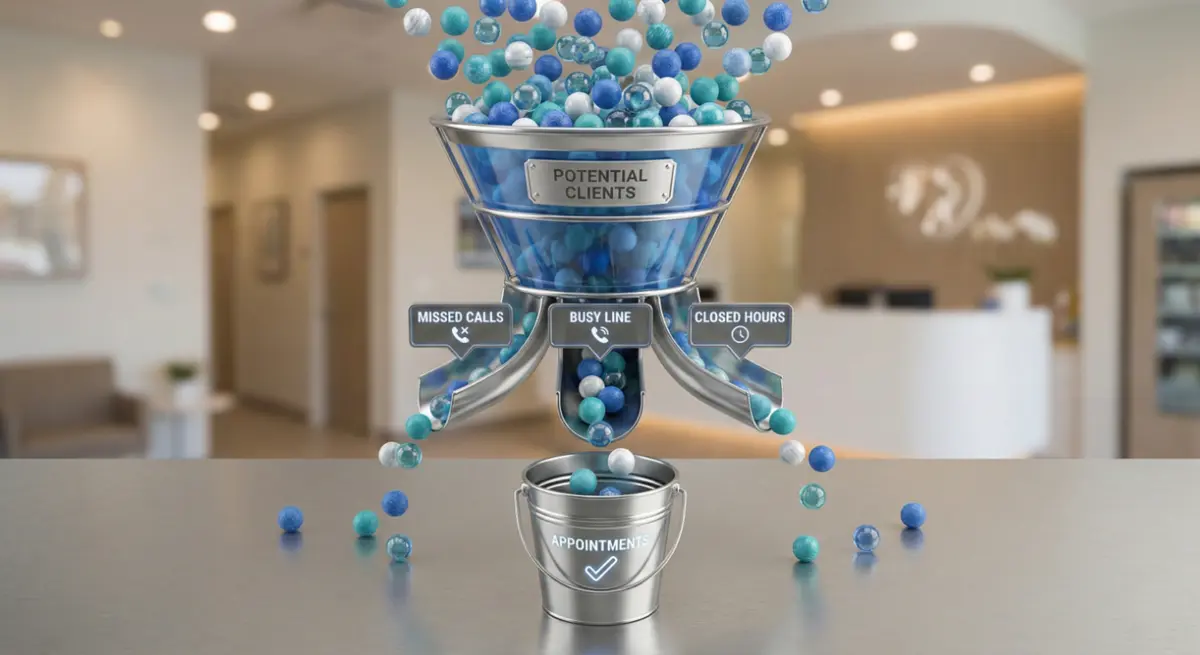
The first thing I want to make clear is that the missed calls problem is not a problem of attitude or team professionalism. It is a structural problem. And understanding this is key to solving it effectively.
In most veterinary clinics, the person answering the phone is not a receptionist dedicated exclusively to that role. They are a veterinary nurse who also manages the schedule, processes invoices, manages stock, assists in consultations, cleans kennels, and in between all of that, tries to answer the phone every time it rings. Many small clinics do not even have a receptionist: it is the vet themselves who takes calls between consultations, with everything that implies for clinical concentration and quality of care for both the in-person patient and the person on the phone.
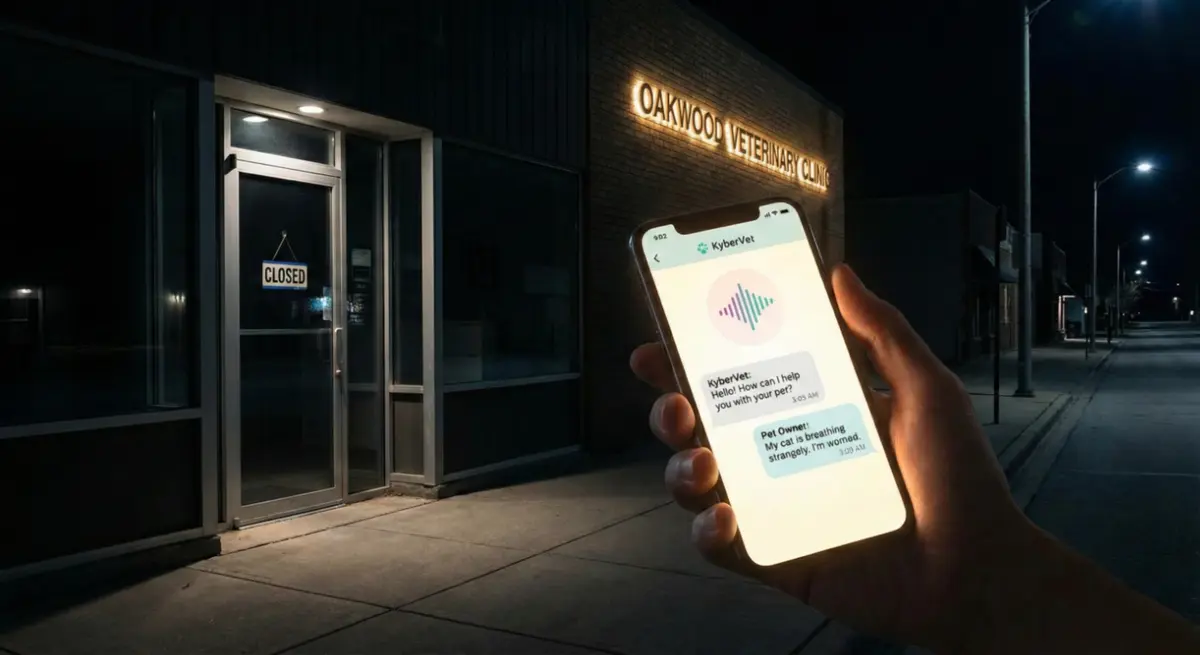
And then there is the issue of schedule coverage. Most clinics operate on split schedules or have midday breaks. Saturday afternoons and Sundays, except in clinics with emergency services, the phone rings into the void. And many of the calls that come during those hours are real emergencies or ones perceived as such by the owner — moments of peak anxiety when the person needs to speak with someone who can guide them, reassure them, or tell them whether they need to go to the emergency clinic.
What does that owner do when they call their trusted clinic and nobody answers? They Google “emergency vet near me,” call the first one that comes up, and if the experience is good, they may never return. We have lost not just an emergency consultation, but potentially a client forever.
The constant interruption: the invisible enemy of the consultation
There is a dimension of the phone problem that directly affects the quality of medicine we practice and that is rarely addressed with the seriousness it deserves: the interruption.
Every time the phone rings during a consultation and someone on the team has to answer it, clinical concentration is broken. The vet loses their train of thought during the examination. The conversation with the owner is interrupted. The flow of the consultation is fragmented. And we all know, even if we do not say it out loud, that repeated interruptions throughout the day contribute significantly to professional burnout, errors from distraction, and that feeling of always running without getting anywhere.
Studies in human medicine have shown that an interruption of just 15 seconds during a complex cognitive task can double the error rate. And our consultations are full of complex cognitive tasks: evaluating symptoms, considering differential diagnoses, adjusting dosages, interpreting results in real time. Every time the phone interrupts that process, we are paying an invisible price in clinical quality.
This is not an exaggeration. It is basic cognitive physiology. And if we multiply those interruptions by five, ten, or fifteen times a day during peak days, the cumulative impact on the quality of our work and on our professional wellbeing is enormous.
The 21st-century client does not wait
In the first articles of this series, we spoke extensively about the new profile of the veterinary client: hyper-informed, digitized, with expectations shaped by their experiences with Amazon, online banking, and streaming platforms. A client accustomed to immediacy and permanent availability.
This client does not understand why a veterinary clinic has no mechanism to handle their call at two in the afternoon or eight in the evening. It does not seem reasonable to them. Not out of whim or irrational demanding, but because their life experience with every other service they consume has taught them that availability is the norm and inaccessibility is the exception.
Let us recall the data we mentioned when discussing the tsunami: 40% of young pet owners are willing to switch veterinarians in the coming year. Not because they are dissatisfied with the medicine, but because they are looking for a more complete, more accessible experience that is more in line with what they already have in other areas of their lives. And phone accessibility is probably the first point of contact where that expectation is put to the test.
Your website may be spectacular. Your Google profile may have five stars. Your team may be clinically brilliant. But if a potential client calls you for the first time and nobody answers, none of that matters. The first filter is brutal in its simplicity: do you pick up the phone? If the answer is no, there are hundreds of clinics that do.
In a world where client loyalty erodes every day, the first battle is won or lost on the phone. And it is a battle that many clinics are losing without even knowing it.
Yesterday’s solutions, today’s problems
What have the traditional solutions to this problem been? Basically three, and all three have significant limitations.
The first is hiring more reception staff. It works, but it is expensive. A full-time reception position costs between 18,000 and 25,000 euros per year in salary and social security costs. And even then, it only covers business hours. Calls outside working hours remain unanswered. Additionally, a human employee has sick days, vacations, moments of overload, and a natural limit on how many calls they can handle simultaneously.
The second is installing an answering machine. It is better than nothing, but let’s be honest: how many times have you left a message on a veterinary clinic’s answering machine when you were worried about your pet? Most owners hang up and call somewhere else. An answering machine generates frustration, not solutions.
The third is outsourcing to a call center. It improves schedule coverage, but the quality of service tends to be generic, impersonal, and with little knowledge of the veterinary sector. The operator cannot distinguish a real emergency from a routine inquiry, does not know the specific services your clinic offers, cannot give concrete information about prices or availability, and the experience for the client feels exactly like what it is: outsourced.
None of these three options solves the underlying problem efficiently, scalably, and in an economically sustainable way.
The alternative that changes the rules of the game
Technology has matured enough for a fourth option to exist — one that was unthinkable three years ago: an intelligent virtual receptionist powered by artificial intelligence.
We are not talking about an answering machine with basic voice recognition, the kind that forces you to “press 1 for appointments, press 2 for emergencies.” We are talking about a conversational assistant that understands natural language, that can hold a fluid conversation with the pet owner, that knows your clinic, your services, your hours, your prices, your emergency protocols, and that can handle the vast majority of routine calls completely autonomously.
A tool like this can operate 24 hours a day, 7 days a week. It has no vacations, it does not get sick, it does not have bad days. It can handle multiple calls simultaneously — something impossible for any human receptionist. And it can do something with real clinical value: perform basic phone triage, evaluating the situation the owner describes and classifying it by urgency level.
The cat vomited once after eating grass? The assistant can reassure the owner, provide observation guidelines, and suggest they book an appointment for tomorrow if symptoms persist. The dog ingested a toxic substance less than an hour ago? The assistant can identify the emergency, provide immediate instructions, and route the call to the on-call vet or the nearest emergency center.
And all of this while generating a structured summary of each interaction that the clinic team can review when they arrive in the morning: who called, why, what they were told, whether follow-up is needed. Organized, available, and actionable information, instead of the usual chaos of sticky notes on the reception computer screen and voicemails no one had time to listen to.
Beyond the phone: WhatsApp, web, and omnichannel communication
The phone is the most critical channel, but it is not the only one. Younger clients — precisely those who are less loyal and more demanding — often prefer to communicate via WhatsApp, through the website chat, or even on social media. Every unanswered WhatsApp Business message, every website chat inquiry left without a response for hours, every Instagram comment requesting information that takes days to get a reply, is another small crack in the client experience.
A smart communication strategy does not stop at answering the phone. It covers every channel through which a client can reach out, with a coherent, fast, and professional response on each one. And artificial intelligence makes this scalable without multiplying the human team.
A smart chat on the website can resolve common questions, capture new client data, and direct them to the online appointment booking. Automated WhatsApp can manage appointment confirmations, vaccination reminders, post-surgical follow-ups, and answers to frequently asked questions. All running in the background, continuously, freeing your human team to focus on what truly requires human intervention: in-person care for clients and patients.
The clearest return on investment in the entire clinic
If there is one technology investment where the return is easily calculable and hard to argue with, it is this one. The equation is straightforward:
Cost of missed calls per year (clients who leave) versus the cost of a solution that answers those calls. If we are talking about tens of thousands of euros in lost business on one side, and the cost of a technology tool that can be a fraction of what an additional reception position costs on the other, the math speaks for itself.
But the return goes beyond the purely economic. It is a reception team that can breathe. A vet who can finish their consultation without interruptions. An owner who always finds an answer when they call. A clinic that projects professionalism and accessibility 24 hours a day. An organized information flow that enables real follow-up on every interaction with every client.
It is moving from a reactive model — where we fight fires every time the phone rings — to a proactive model where client communication is designed, automated, and managed intelligently.
The question you should ask yourself first thing tomorrow
Tomorrow, when you arrive at your clinic, ask yourself a simple question: how many calls were missed today? Most modern phone systems log incoming calls, including unanswered ones. Look at that number. Multiply it by five days. By four weeks. By twelve months.
That number is your baseline. It is what is happening right now at your clinic, probably without you having put numbers to it until this moment. And once you see the number, it is hard to ignore.
This is not about blaming the team. It is about recognizing that we have a structural problem that is solved with structure, not with effort. Asking your team to try to answer more calls is like asking a surgeon to operate faster: it is not the solution, and it can make things worse.
The solution is to design a system where no call is missed, where the human team can focus on the in-person care that is their true strength, and where the client always finds a professional, informed, and empathetic response on the other end of the phone — no matter the time.
The phone is not just a device at reception. It is your clinic’s front door. And right now, that door may be closed more hours than you think.
This article is part of the “AI & Veterinary Medicine” series by KyberVet. If you want to know how much your unanswered calls are really costing you, write to us at info@kybervet.com. We can help you calculate the impact and find the right solution for your clinic.