We have already analyzed the why (the client as the driver of transformation), the what (the three waves impacting our clinics), and how to evaluate (the manual for telling good AI from empty products). Now it is time to open the toolkit. Because there is no point in understanding the theory if we do not ground it in concrete actions you can start implementing in your clinic.
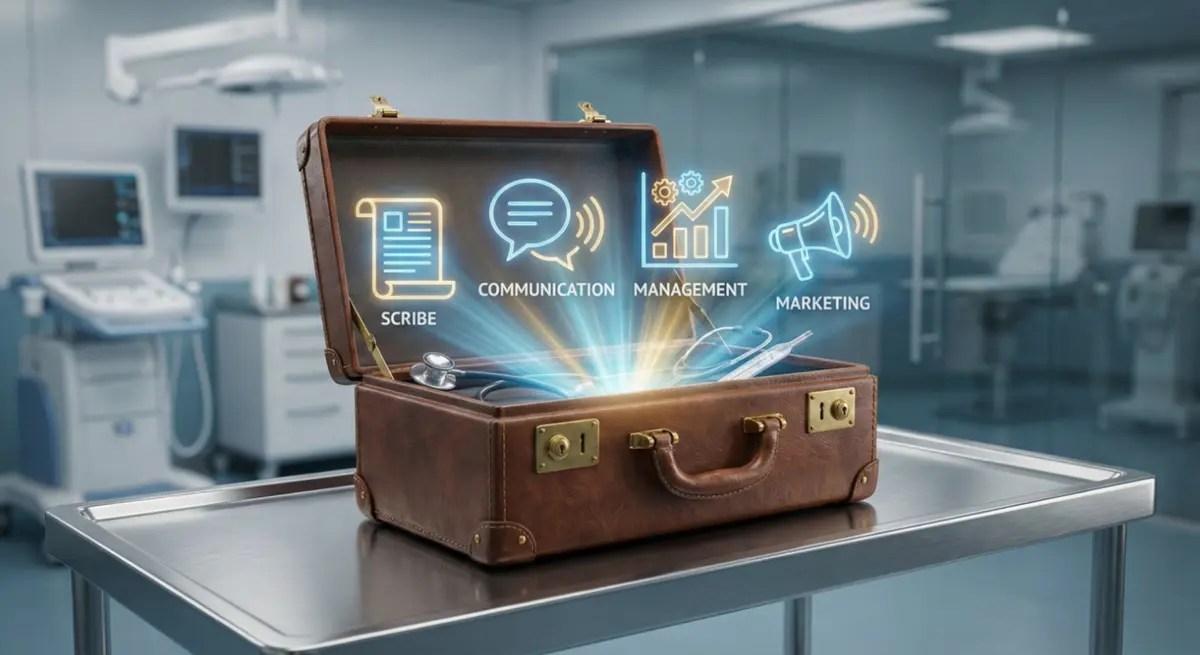
To organize the universe of AI tools available for the veterinary sector, I propose a classification into two broad categories that every professional should understand. Today we focus on the first: automation AI. This is where the quick wins and the most immediate return on investment are found.
Two types of AI, two completely different missions
Before we get into specific tools, it is essential to understand the distinction between the two types of AI we can incorporate into our practice:
Automation AI is the tireless assistant. Its mission is clear and straightforward: to handle the repetitive, administrative tasks that steal time from us every day, and give it back. It is the helper that works 24 hours a day, 7 days a week, without getting tired, without making mistakes from fatigue, without having bad days, and without needing vacations. Its goal is to free us from the administrative burden so we can dedicate more time to medicine.
Decision-support AI (which we will explore in depth in the next article) is the expert colleague who is always available. Its mission is to help us think better and make more evidence-based clinical decisions. It does not do the work for us — it helps us do it better.
Today we focus on the first category, because this is where the improvements with an immediate, measurable impact on any clinic’s daily operations are found, regardless of size or specialization.
Smart documentation: the invisible scribe
If I had to choose a single area where AI is having the greatest immediate impact on veterinary clinics around the world, it would be this one without any doubt: clinical documentation.
Veterinary professionals spend a disproportionate amount of our time documenting. SOAP notes, medical histories, referral reports, client instructions, follow-ups… It is necessary work, indispensable for good clinical practice, but it steals hours that we should be dedicating to medicine and to our patients.
Smart transcription tools, known as AI scribing, are changing this at the root. They work as an invisible scribe: they listen to the conversation during the consultation (with the client’s consent, naturally) and automatically generate the clinical note in SOAP format. You focus on the patient and their owner, and by the time the consultation is over, the note is ready for your review.
But smart documentation goes far beyond simple transcription. These tools can automatically create summaries tailored to the recipient: technical and detailed for the specialist you are referring the case to, and simple, clear, and jargon-free for the owner. They can generate personalized post-consultation follow-up emails — the ones you know you should send but never have time to write. They can take a 50-page clinical history accumulated over years of visits and summarize the key points in a matter of minutes, preparing you for a consultation with all the relevant information at hand.
Imagine being able to dictate a protocol, notes on a complex case, or instructions for a client from the car on your way home, and having them transcribed, formatted, and ready to send or file by the time you arrive. That is already possible today with accessible tools at a reasonable cost.
In practice, clinics that have adopted these tools consistently report saving between one and two hours of administrative work per day per veterinarian. Think about what two recovered hours per day means, multiplied by five days a week, by fifty weeks a year. That is five hundred hours annually. More than twenty full working days that you can spend seeing more patients, dedicating more minutes to each consultation, training, or simply getting home at a reasonable hour with the energy to enjoy your personal life.
Two fewer hours documenting means two more hours practicing medicine, caring for patients, and connecting with clients. That simple and that transformative.
Smart communication: the clinic that never closes
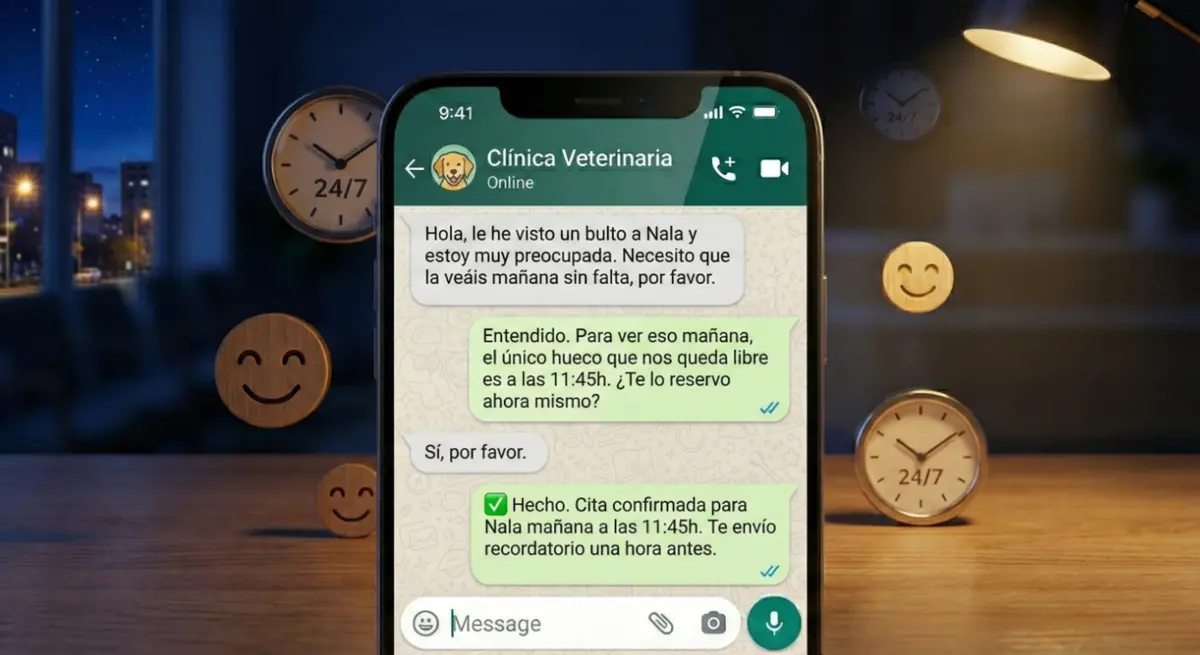
The second area of immediate impact is client communication, and this is where the concept of the digital receptionist comes into its own.
Think about the questions your reception team answers every day. What are your hours? Where exactly are you located? Do you handle nighttime emergencies? Do you see exotic animals? How do I book an appointment? How much does a spay roughly cost? What do I do if my dog has eaten chocolate? They are the same fifty questions asked over and over again, day after day, consuming precious time from your team.
Today’s smart chatbots, correctly configured with your clinic’s specific information, can handle these queries via WhatsApp or through your website completely autonomously, responding with accuracy, friendliness, and consistency twenty-four hours a day, seven days a week.
The new generation of virtual assistants also includes voice capabilities: they can receive phone calls, classify them by urgency, provide basic information, and when the situation requires it, escalate the call to a human team member. They can perform automatic post-consultation follow-ups: How is Luna doing after the surgery? Has she tolerated the medication well? Do you need to schedule a check-up?
All of this without your human team having to be permanently glued to the phone. It is a clinic that, from the client’s perspective, never closes and is always available — but without burning anyone out in the process.
And there is an additional benefit that is often overlooked: consistency. A well-configured chatbot always gives the same correct, up-to-date information. It does not have bad days, it does not forget to mention an important detail, it does not get confused by the August holiday schedule, and it does not give outdated information. The quality of communication is standardized upward.
Smart marketing: from selling to connecting
The third area where automation makes a significant difference is marketing and the proactive client relationship. And here I want to make an important distinction: we are not talking about selling more aggressively. We are talking about connecting better.
Language models can draft informative and educational newsletters, awareness materials for owners, social media content, and articles for the clinic’s blog. Image generation tools allow you to create professional visual material for your communications without needing to hire a graphic designer for every post.
But the truly powerful aspect of AI applied to veterinary communication is not content generation itself. It is personalization at scale. Imagine a system that automatically sends the right message, to the right client, at the right time. Smart preventive reminders based on the age, breed, and specific history of each pet. Educational content relevant to the animal’s life stage — not a generic, one-size-fits-all email.
And even something more sophisticated and valuable: early detection of clients at risk of leaving. A smart system that identifies worrying patterns — a client who has not visited in eight months, who has declined the last two treatment recommendations, whose visit frequency has dropped compared to the previous year — can alert us to act proactively, with a personal call, a check-up offer, or simply a message of genuine interest. It allows us to retain rather than chase. To prevent loss rather than regret it.
Smart management: from firefighting to leading with data
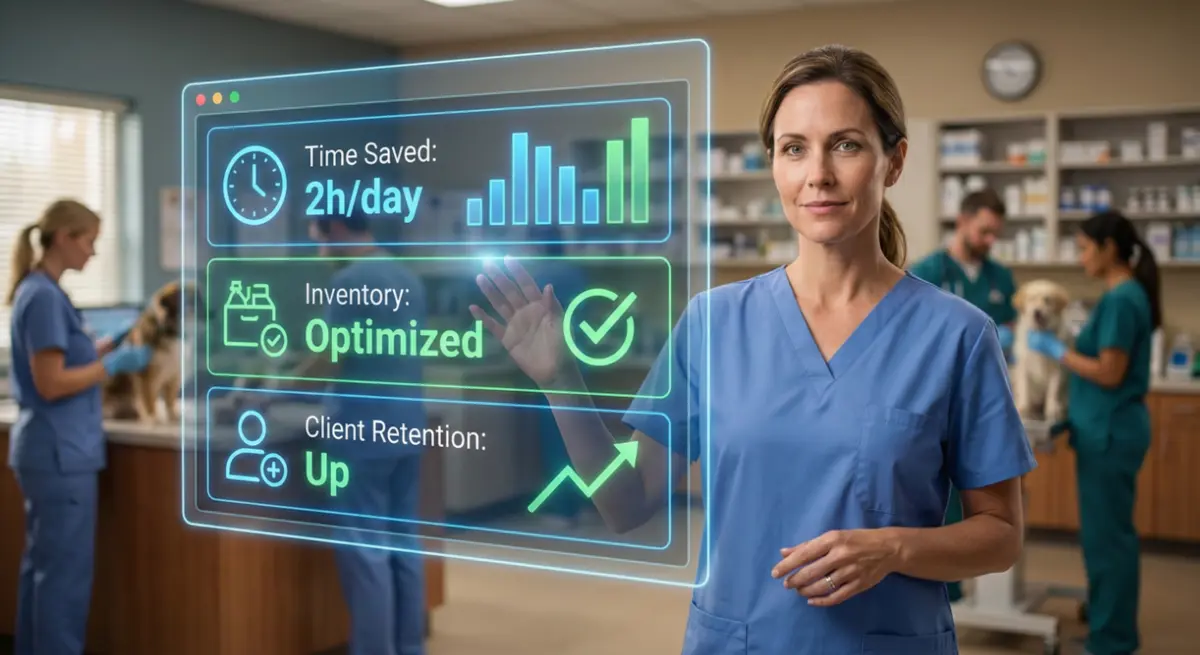
The fourth area of automation is the clinic’s operational management. And this is where we stop constantly firefighting and start leading with data and foresight.
We are talking about smart schedule optimization — not just filling gaps, but taking into account the type of consultation, the actual time each procedure requires according to your own historical data, the best-suited veterinarian for each case, and cancellation and no-show patterns.
We are talking about automatic analysis of key business metrics, presented in a clear, visual, and actionable way. Not a thirty-page report that no one has time to read, but the three or four indicators you need to see every morning when you arrive at the clinic to know how things are going and where to focus.
We are talking about inventory forecasting: systems that analyze consumption patterns, seasonality, and trends, and alert you before a product runs out — avoiding stock-outs that result in lost sales or, worse, the inability to properly treat a patient.
All of this gives us something that veterinary professionals desperately need: the time and information necessary to stop managing purely reactively and start leading in a genuinely strategic way.
The near horizon: AI agents
The next evolutionary step, which is already materializing in the market, involves what are known as AI agents. If the tools we have described assist us when we ask, agents go one step further: they act on our behalf within parameters we define in advance.
An agent can issue an invoice when a consultation is completed, contact the client via their preferred channel to confirm an upcoming appointment, automatically reschedule when there is a cancellation, send the vaccination reminder, and manage the client’s response until the new appointment is confirmed. It does not just assist passively — it actively executes complex tasks involving multiple steps.
But even in this more advanced scenario, one thing never changes: AI automates the execution of tasks, but the judgment, clinical strategy, supervision, and final responsibility remain ours. We define the rules of the game and the boundaries of action. AI executes them tirelessly, consistently, and at scale.
Automation does not take away control. It gives us the control we never had because we were too busy putting out fires to think strategically.
In the next and final article in this series, we will open the second compartment of the toolkit: clinical decision-support AI. We will talk about how these tools give us diagnostic superpowers, why they are the best antidote to our cognitive biases, and what the veterinarian’s Hero’s Work truly means.
This article is part of the “AI & Veterinary Medicine” series by KyberVet. If you found it useful, share it with your team. Transformation is a journey best traveled together.