In the previous article, we explored how the real driver of transformation in veterinary medicine is not technology, but the client. A hyper-informed client, less loyal, with digital expectations shaped by their experiences with Amazon, Netflix, and online banking. Now it is time to ground that idea in concrete, tangible impacts.
Because transformation is not an abstract concept. It manifests in specific waves that are reaching our clinics and that will fundamentally change how we work, how we set prices, how we relate to those who entrust us with the health of their pets, and how our own internal systems operate.

Let us analyze the three major waves of this transformation.
First wave: The end of price opacity
The first wave is already making landfall, and it has to do with something that has historically been an especially opaque area in our sector: pricing.
Think about it honestly for a moment. For a client, comparing prices between veterinary clinics has traditionally been an almost impossible mission. How much does a dental cleaning cost? What about a full blood panel? What exactly does an annual check-up include? Every clinic structures it differently, names it differently, includes or excludes different items. Direct comparison was, in practice, unworkable. And many clinics, consciously or unconsciously, have benefited from that opacity.
Now imagine this: an application that uses an AI agent to automatically contact every clinic in a neighborhood or a city, asking for the price of specific services. The agent makes the phone call, asks questions naturally, records the answers, and organizes them. In a matter of minutes, the client has a clear comparison table on their phone, organized by service and price, with notes on what each option includes.
This is not science fiction. The technology to do it exists right now. The major tech players are actively developing AI agents capable of performing these tasks completely autonomously. Agents that can hold phone conversations indistinguishable from those of a human, ask relevant follow-up questions, and collect information in a structured way. And if that specific application for the veterinary sector does not yet exist in your country, someone will create it in the coming months. The question is not whether it will appear, but when.
What does this mean for us? That competition is going to force the entire market to become more transparent. To justify every euro we charge. To explain clearly and accessibly why our service is worth what it costs. In a sector where trust is the fundamental pillar of the client relationship, transparency is going to become the new currency for building and maintaining that trust.
Clinics that embrace this transparency proactively — publishing clear prices on their website, explaining their services in detail, and actively communicating the value they provide — will attract that new generation of clients who compare before they decide. Opacity will simply cease to be a viable commercial strategy.
And there is an important nuance here: transparency does not mean competing on price. It means competing on value. A client who understands why a blood panel at your clinic costs what it costs, what it includes, what quality of equipment stands behind it, and what professional experience supports it, is a client willing to pay a fair price. What they will not tolerate is obscurity.
Transparency is not a threat. It is the new loyalty tool for clinics that know how to communicate their value.
Second wave: When the client sits beside you
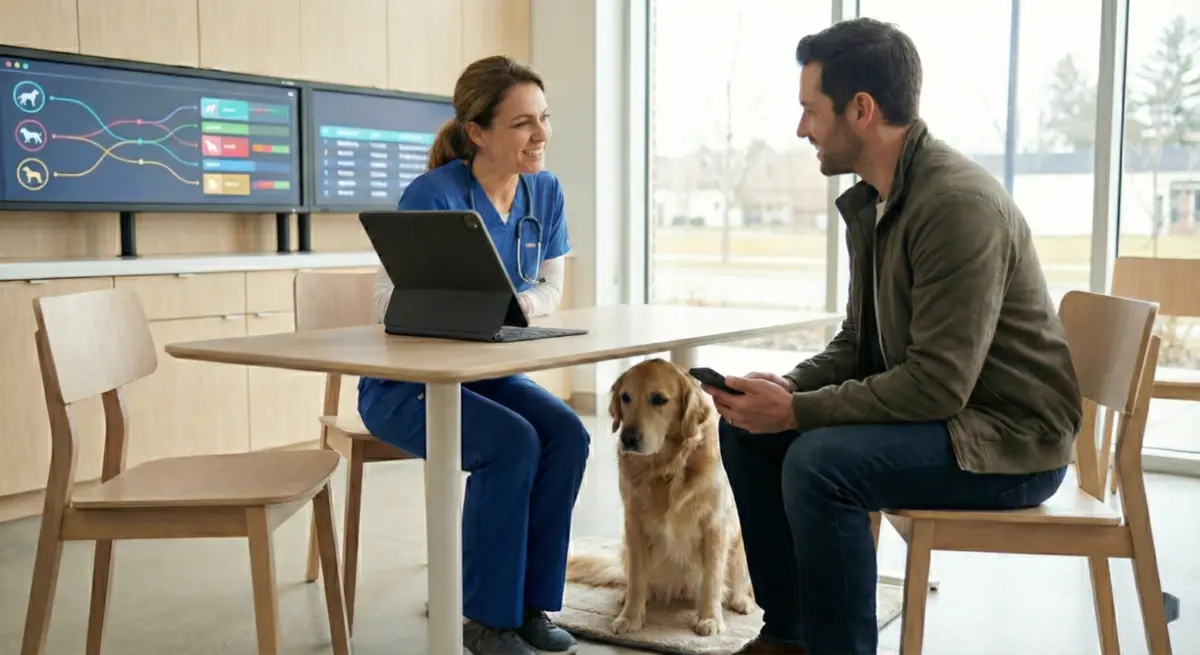
The second wave runs deeper, because it touches the very essence of our professional role as veterinarians. And to understand it, we need to talk about an economic concept that has sustained our profession for decades without us ever naming it: information asymmetry.
For generations, the value of the veterinarian has largely been based on the fact that we had the knowledge and the client did not. We were the exclusive holders of clinical expertise. The client trusted us because, quite simply, they had no other option. They could not verify, cross-reference, or meaningfully challenge what we told them. Our privileged access to medical knowledge was, in itself, a barrier that protected us.
Today, a pet owner can upload their dog’s complete clinical history to a language model like ChatGPT and get, within seconds, a structured summary of possible differential diagnoses, treatment options, estimated prognoses, and even questions they should ask their vet. I am not saying those results are correct — they often are not. AI can generate plausible but completely wrong diagnoses. But the client gets them. And they arrive at the consultation with radically different expectations from those they had five years ago.
They are no longer a passive patient waiting for a verdict. They are someone who has read, who has asked questions, who arrives with their own hypotheses and a list of specific questions. They expect us to raise the bar — both in the depth of our evaluation and in the clarity with which we communicate it. They expect transparency, understandable explanations, and active participation in decision-making.
So, is this a threat? Only if we continue to believe that our value lies exclusively in being the gatekeepers of knowledge, in being inaccessible oracles who issue verdicts from a position of one-sided authority. In reality, it is an extraordinary opportunity to redefine and elevate our professional role.
We are no longer the sole holders of knowledge. We are the experts who help clients navigate an ocean of information, separate the valid from the erroneous, contextualize data with the specific clinical reality of their pet, and make the best possible decision with all the information on the table.
We shift from being an oracle to being an expert guide. From a one-way professional monologue to a dialogue between informed individuals. And this, when managed well, can exponentially strengthen the client relationship. A client who feels heard, who understands the decisions, who actively participates in the care of their pet, and who perceives that their vet welcomes their questions with professionalism rather than irritation, is a far more committed, more satisfied, and — paradoxically — more loyal client than the passive client of the past.
Third wave: The quiet revolution in our systems

The third wave is happening inside our own clinics, in our management systems, and many professionals have not yet grasped its magnitude.
For decades, the PIMS (Practice Information Management System — the clinic management software) has been the nerve center of everything. Patient records, billing, scheduling, inventory, client communication… it all went through there. It is what we technically call a system of record: a fundamentally passive tool where we enter data and retrieve it when we need it.
But now a series of tools are emerging that operate on a completely different logic. They are specialized AI applications that start by solving a very specific problem — for example, automatically transcribing consultation notes from a recorded conversation — and then progressively expand to manage more and more tasks within the clinic.
These tools are not passive record systems. They are what we might call proactive action systems. They do not wait for you to ask: they anticipate needs, suggest actions, automate processes. And because they were designed from the ground up to work with artificial intelligence, they are far more agile, more intuitive, and can offer functionalities that traditional PIMS would take years to develop and integrate.
Little by little, these applications are taking over functions that historically belonged to the PIMS. And this raises an uncomfortable question for traditional management software developers: will they adapt by opening up their platforms, or will they try to resist by protecting a business model that is eroding?
The smartest answer — and the one already being adopted by the most visionary management systems — is to open up. To create seamless integrations with these new specialized tools rather than trying to develop every possible functionality in-house. The closed ecosystem is giving way to an open, interconnected ecosystem, where the PIMS remains an important piece of the puzzle — but no longer the only one.
The management systems that will survive are those that understand their strength no longer lies in being a closed fortress, but in being an open platform that connects with the best available ecosystem of tools.
The convergence that changes everything
What is truly transformative is not each wave on its own, but their convergence. When an informed and demanding client (driven by the first and second waves) interacts with a clinic that has integrated agile AI tools into its workflow (third wave), the resulting experience is radically different from what we know today.
It is a clinic that communicates with total transparency, that treats the client as an ally in the care of their pet, and that operates with an efficiency that frees up time for what truly matters: medicine and the human connection.
In the next article in this series, we will move from context analysis to the practical: what is AI really? What is it not? And above all, how can we evaluate it intelligently so we do not fall into either analysis paralysis or the impulsive purchase of tools we do not need?
This article is part of the “AI & Veterinary Medicine” series by KyberVet. If you found it useful, share it with your team. Transformation is a journey best traveled together.