
 Phase 2 · You do more than write now
Don't ask: hand it the work order sheet
Diego cross-checks invoices by hand for three hours and forty minutes a month. Instead of asking the AI to "build me a screen", he hands it his work order sheet: what he gives it, what has to come out, what it must never do and what he doesn't want. The tool is up in three minutes, whole though not perfect, and gets corrected with changes one at a time.
Phase 2 · Lesson 4 of 13
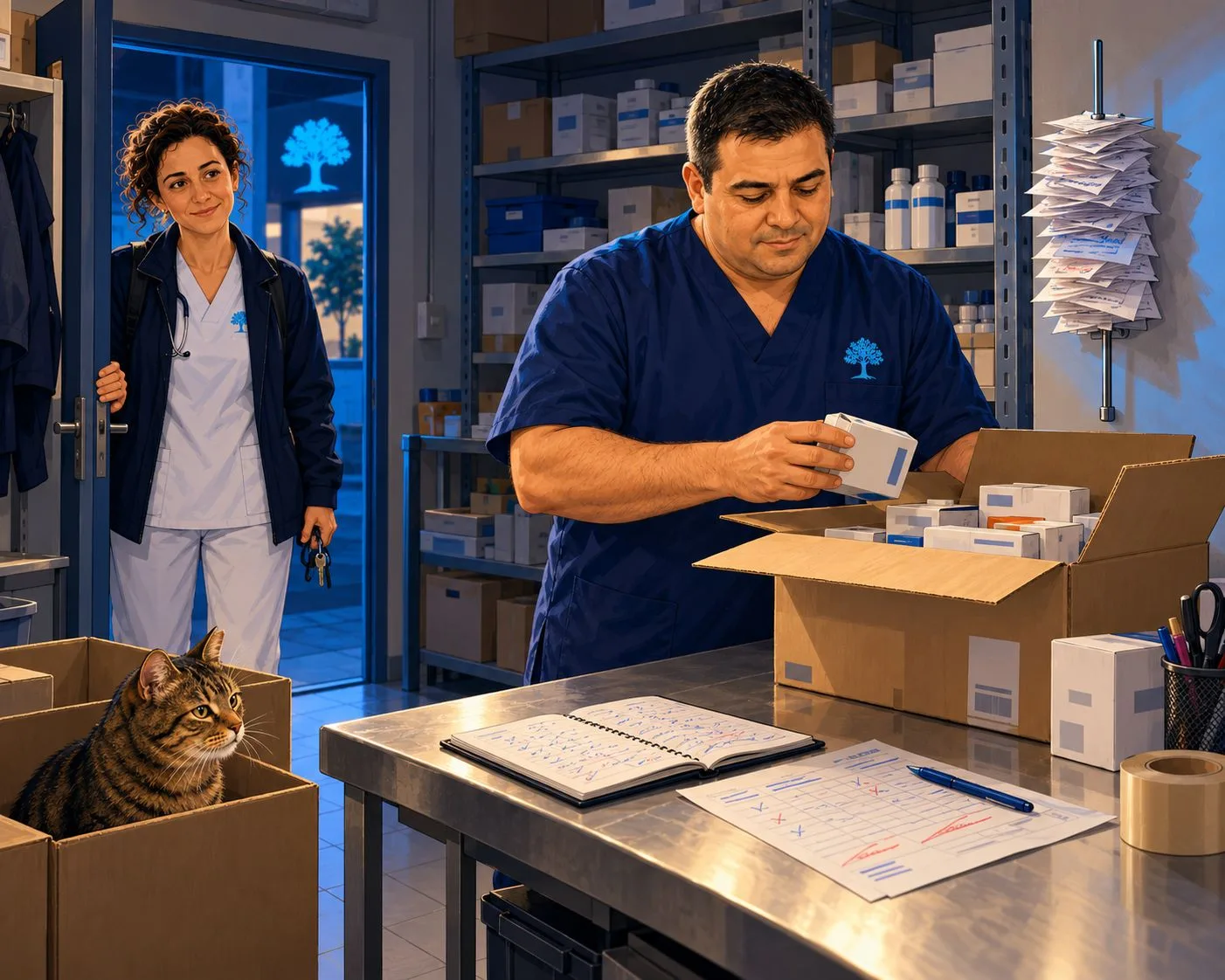
A fictional story about Clínica El Roble. Names, suppliers, data and dates in the exercise are synthetic (simulated month: October–November 2026); they do not represent real balances or transactions.
The full story · Clínica El Roble
1 · The scene
Thursday, twenty past eight. The clinic is already closed and the light from the Olmos Street sign comes through the glass door and reaches, blue, all the way to the stockroom corridor.
Diego has the Corvalán box open on the table. Delivery note on the left, box on the right, the blue pen in his hand and the red one behind his ear. He does it the same way every time. He takes an item out, counts it, checks the lot number, checks the expiry date, checks the container isn't dented, and puts a tally mark next to the line. If anything is missing, he circles the quantity in red and notes it in the margin. He signs and writes the date.
Then comes the other thing. He opens the black-covered notebook and copies out the delivery note: supplier, number, every line, whatever was missing. Five minutes. Without the notebook, there is no way on day 3 to cross anything off. And the paper, up on the corkboard.
There are nineteen papers on the corkboard. It's the October nineteenth box.
Nothing escapes Diego, and everyone at El Roble knows it. If a box arrives two sutures short, he writes it down. If the sales rep promises him a credit for some syringes that arrived broken, he notes it at the foot of the first delivery note of the month, in his own handwriting: credit for broken syringes sept. €31.40 — pending. There it still is, on the sheet of paper one further down the corkboard.
What weighs on him isn't this. It's day 3. Each supplier's monthly invoice arrives and Diego sits down with the notebook, the corkboard, the invoice, each supplier's price-list Excel open in another tab, the paper with the agreement and its discounts, and the phone calculator. Line by line. An hour and three quarters if nobody interrupts him, and somebody always interrupts him.
Roble comes out from under the table, looks at the empty box and gets inside it.
2 · The nudge
Marta comes down with her coat on. Hugo is right behind her, jacket half on and phone in hand, which is how Hugo comes out of everywhere.
—Go home, Diego. You'll look at it tomorrow.
—Tomorrow three more arrive.
He doesn't say it as a complaint. He says it like someone reading out the weather.
Marta stays at the stockroom door and looks at the corkboard.
—How long does each one take you?
—Counting it, however long it takes. Writing it down, five minutes. More if something's wrong.
—And how many are there a month?
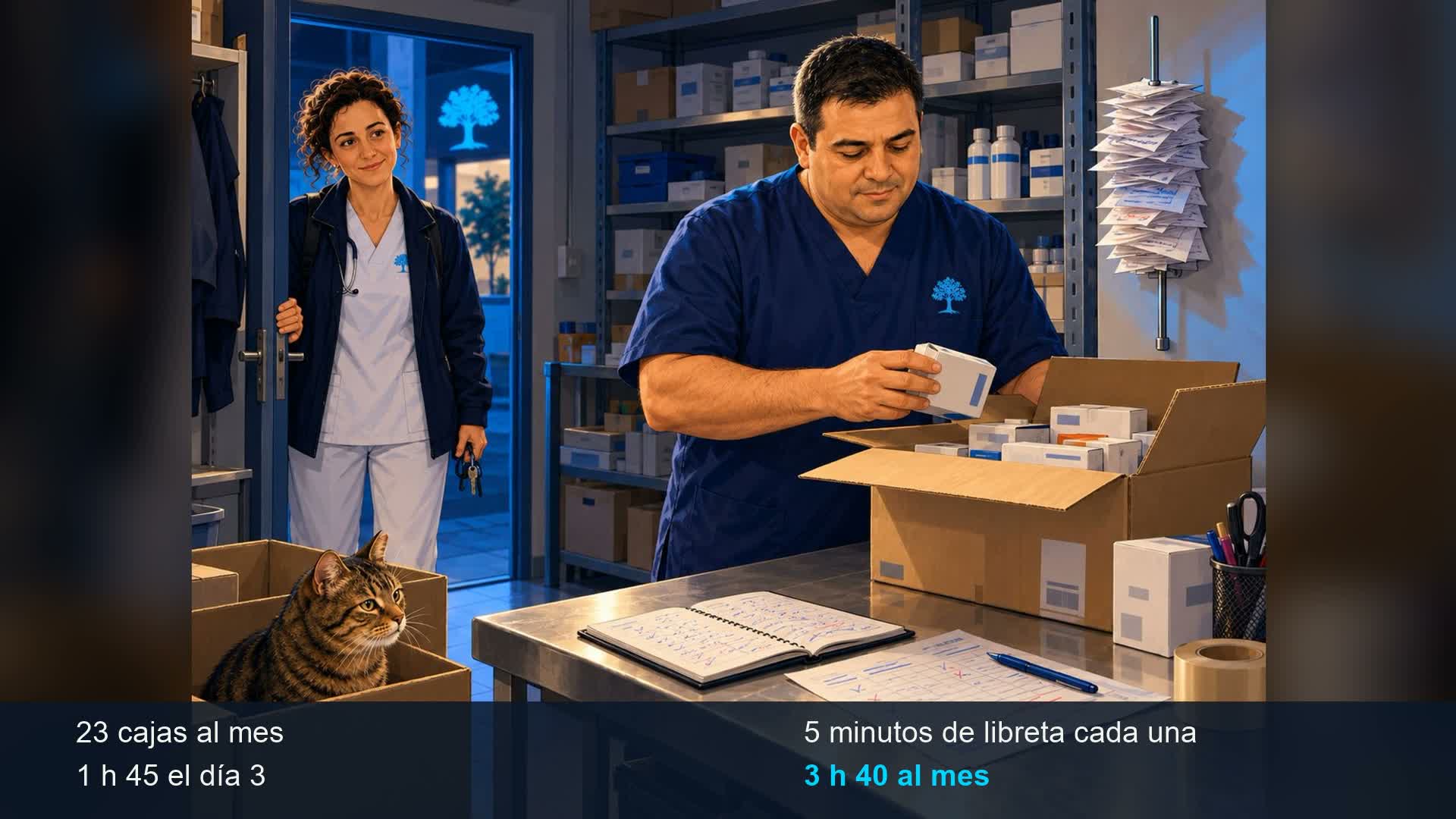
Diego has never counted them. He counts them now, out loud, looking at the corkboard: twenty-three boxes, five minutes of notebook each, and the hour and three quarters of day 3.
—Three hours and forty.
—A month, says Marta.
—A month.
Marta doesn't argue with the number. She turns it around.
—And of those three hours, how much actually has to be you?
Diego genuinely thinks about it, because he's one of those who think before answering. Counting, yes. Checking the lot number and the expiry, yes. Seeing whether a box came crushed, yes. Nobody else is going to do that; only the person who opens the box can.
—I have to open the box myself. The rest is copying, a calculator and an Excel open in another tab.
Hugo is already typing. It takes him as long as walking down the last step.
—Wait. —He types with his thumbs and reads aloud as he writes—: I need a screen to control what comes in from suppliers. Done.
He turns the phone around before anyone asks him to. The answer is long, tidy and correct: two screens, one for receiving and one for controlling, a form with its fields, and a receiving, cross-checking and validating workflow. And at the end, a question: Which environment are you planning to build it in? Airtable, Notion, AppSheet…? Nobody at El Roble has heard of any of them.
—Here you go. —And then, with half a smile—: Weren't you doing a course on this?
Diego reads the whole screen, unhurried. He doesn't laugh, but he isn't offended either.
—You asked it how it would do it. And it told you.
—What was I supposed to ask it?
—Nothing. You don't ask that.
Marta buttons up her coat and leaves them there. From the street door, without turning round:
—Tell me about it tomorrow. But today you're going home.
Diego goes home. He takes the notebook with him.
3 · The task
The black-covered notebook is ten months old. The same columns on every page since January, which nobody told him to set up: supplier, number, date, what it says, what arrived. And in the margin, in red, what went wrong.
That night, with the little girl asleep and the kitchen tidy, Diego doesn't open the computer. He opens the notebook at the beginning and goes through the pages looking for the red.
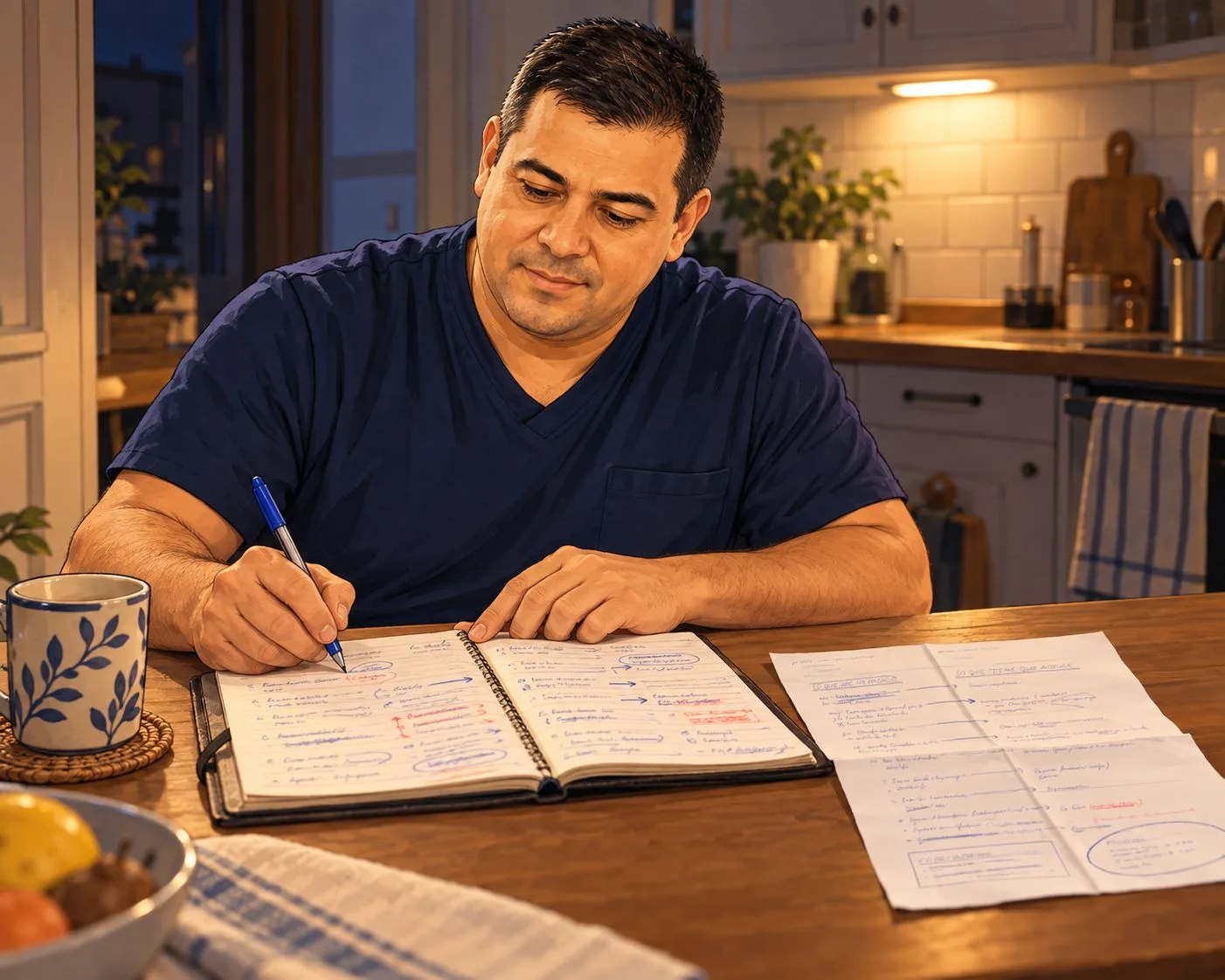
When they set up the arrears thing, Sara needed someone to ask her, because what she knew wasn't written down anywhere. Diego already has it written down. He's been writing it in the margin for ten months.
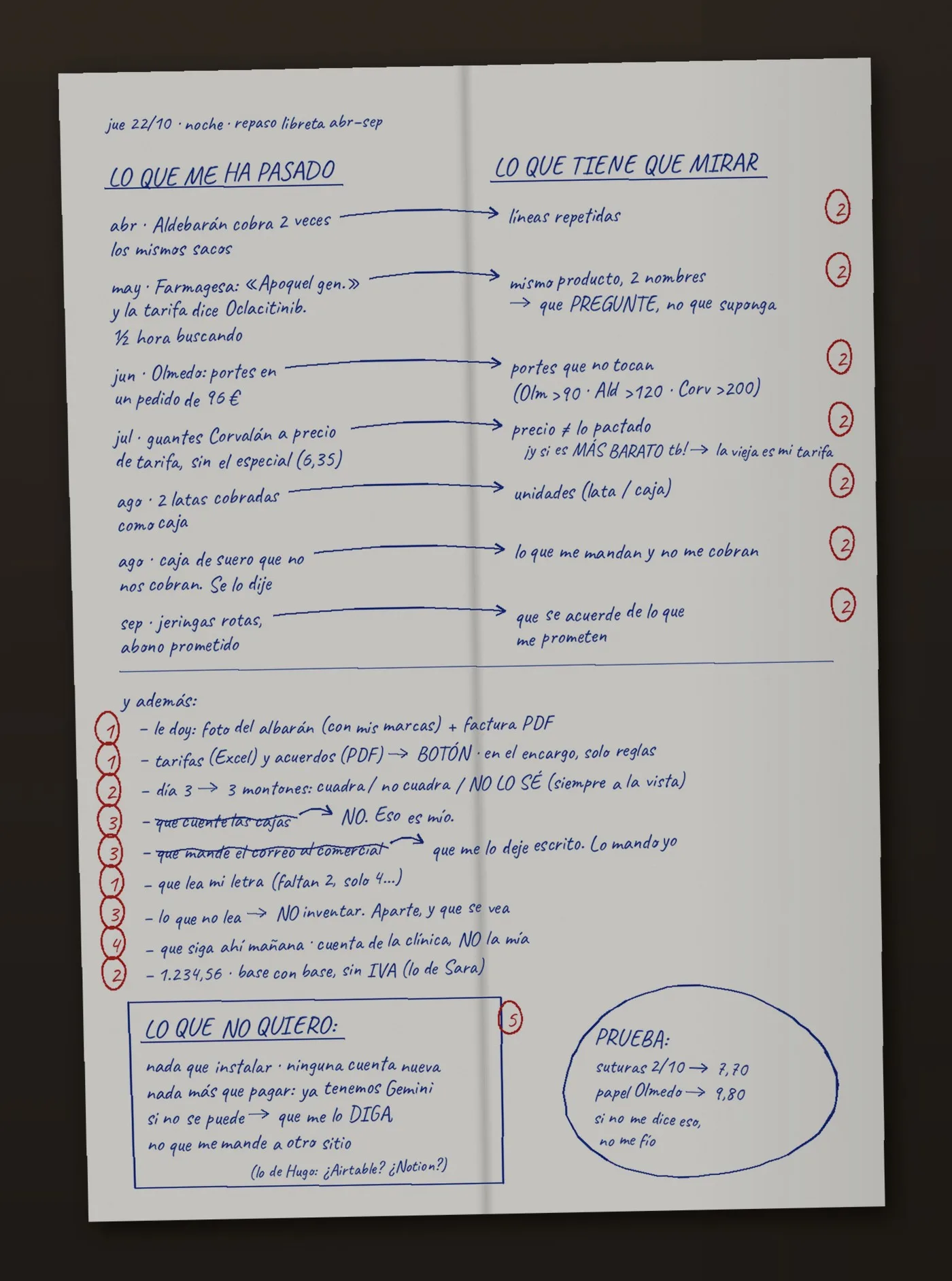
He takes a sheet of paper and folds it in half. On the left he writes what has happened to me. On the right, what it has to look at.
April. Aldebarán bills the same sacks twice. Arrow: duplicate lines.
May. Farmagesa writes "Apoquel gen." on the delivery note and "Oclacitinib" on the price list. Half an hour to work out whether it was the same thing. Arrow: the same product under two names → have it ask me, not assume.
June. Shipping charges on an Olmedo order of ninety-six euros. Arrow: shipping charges that don't belong.
July. Corvalán's gloves at list price, 7.90, and I have a special price of 6.35. Arrow: a price different from what was agreed. And below it, after thinking about it: also if it's cheaper. Then the old one is my price list.
August. Two cans charged at box price. Arrow: units.
August. They send us a box of serum they don't charge us for. I said so. Arrow: what they send and don't charge for.
September. Broken syringes. Credit promised. Arrow: remember what they promise me.
Then he writes the ideas that occur to him without looking at the notebook, and crosses out half of them.
That it count the boxes. Crossed out. Next to it: no. That's mine.
That it send the email to the sales rep. Crossed out. Have it leave it written. I send it.
That it read my handwriting. He keeps it. And below: and what it can't read, it mustn't make up. Set it aside, and make it visible.
At the very bottom, thinking about the question that came back to Hugo, he writes in capital letters: WHAT I DON'T WANT. And below: nothing to install, no new account, nothing more to pay: we already have Gemini. If it can't be done, tell me so, don't send me somewhere else.
And in the corner, circled, what he will use to decide whether it can be trusted: TEST: the October 2nd sutures and the Olmedo paper. If on day 3 it doesn't tell me that, I don't trust it. They're the two he marked himself, in red, the day they arrived.
The sheet ends up full of arrows. Diego looks at it and sees that it's all there, but disorganised. He takes the red pen from behind his ear, where it has been all day, and does what he does with the boxes: puts each thing in its place. Next to each note, a small circled number, one to five. One, what I give it. Two, what has to come out. Three, what it must never do. Four, where it's stored. Five, what I don't want.
The seven notebook lines get a two. What happened to him over six months is exactly what has to come out. The two crossed-out items get a three.
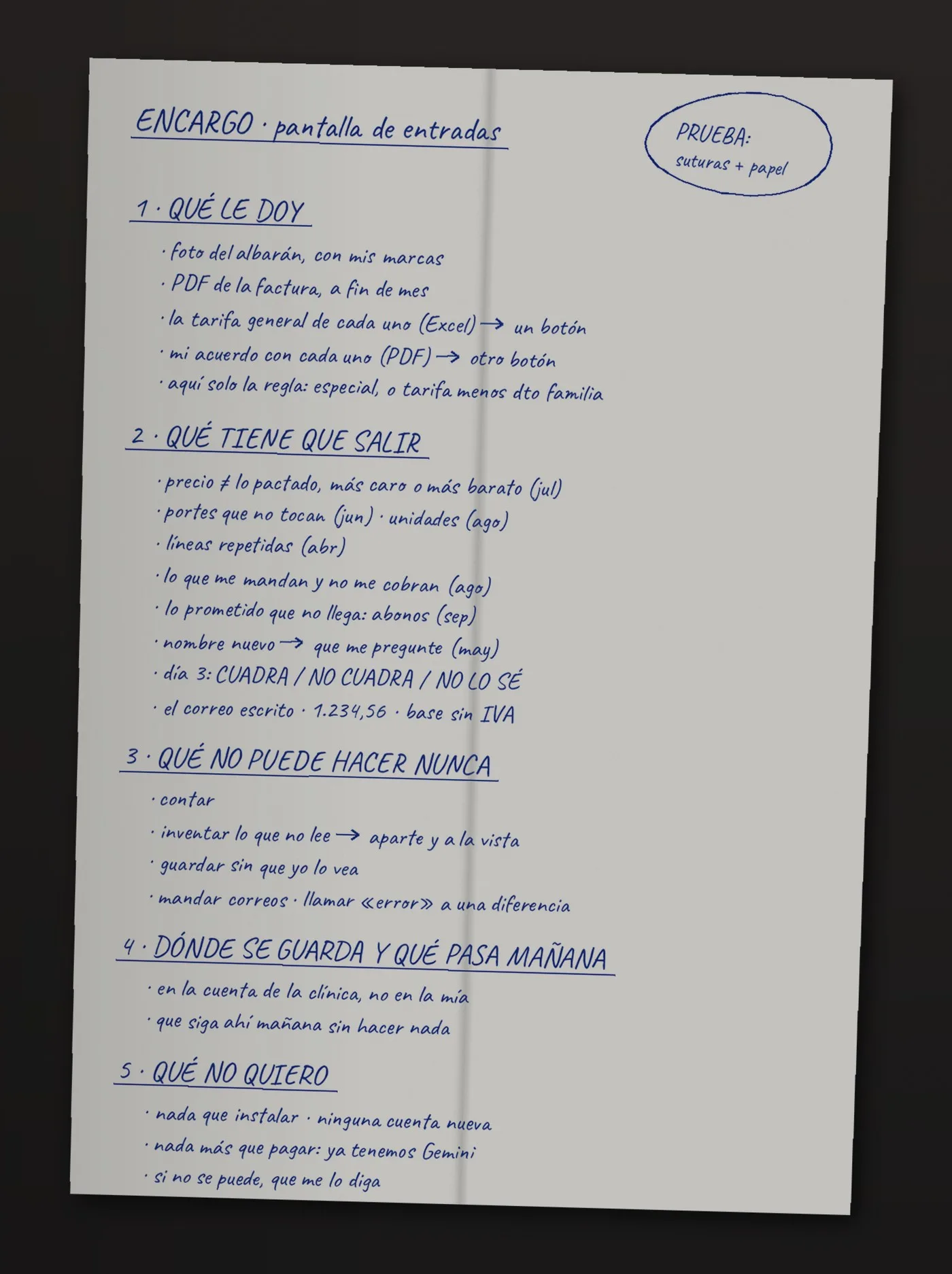
He turns the sheet over and writes at the top WORK ORDER, and below it the five questions, and goes through each thing under its heading, with the month in brackets to remember where it came from. He copies the test in the top corner, circled once again.
The fifth is the only one that doesn't come from the notebook. It comes from Hugo.
Half a page. That's the work order. What's left is writing it up clean, and he does that on Friday morning on the stockroom computer.
Not on his own account. Diego pays for one out of his own pocket, the one he learns with at night, and on that one it would have gone faster. He builds it on the clinic's Gemini account.
—Why that one? —asks Hugo, who has come down to see whether he took it seriously.
—Because the day I'm not here, this has to keep existing.
Before pasting anything in, he opens the account's settings and checks what gets stored from what you upload and what doesn't. He looks at it the way he looks at an expiry date.
He types the work order with the sheet next to the keyboard, question by question, with the headings in capital letters. He adds two sentences at the start that aren't on the sheet: build it here, and don't ask me anything beforehand; everything you need is down there. There isn't a single price in the work order. The rule is there (the special price if there is one; otherwise the list price minus the family discount), but not the numbers. Each supplier's price list is hundreds of lines in an Excel file that changes whenever the labs change. The agreements belong to the clinic, they carry its name and its customer code, and next year they'll be different ones. For both things he asks for a button. That way the sheet can be shown to people, and in January the agreement is changed without touching the screen.
Hugo reads it over his shoulder.
—This is what I asked it.
—This is what you asked it —says Diego— plus ten months.
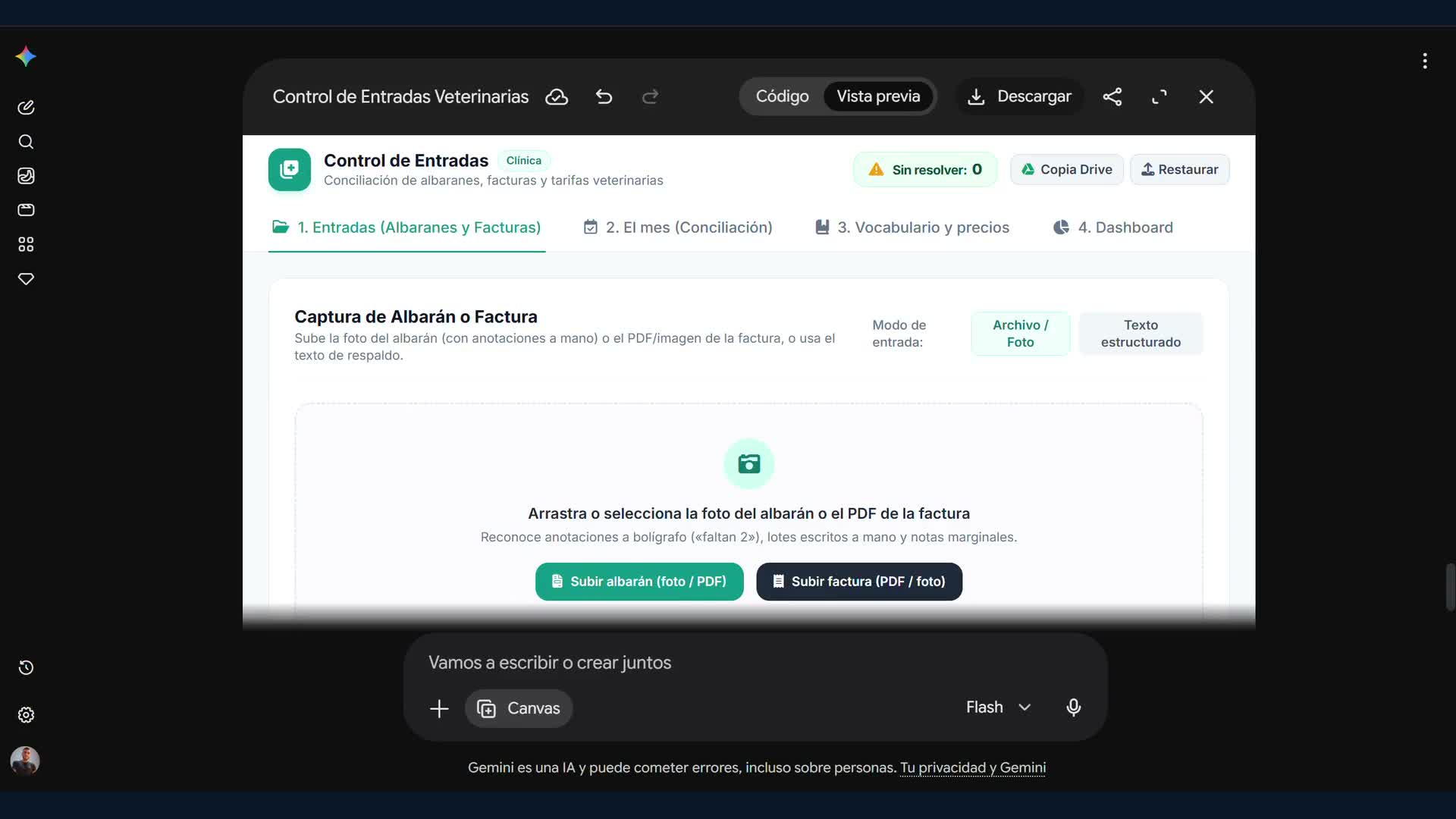
He pastes it in. In three minutes the screen is there. Three tabs, a counter at the top that says unresolved: 0, a place to upload the photos and the invoices, another for the price lists and the agreements. It hasn't asked anything, because it didn't need to.
It doesn't come out perfect. It comes out whole. As soon as he starts feeding it papers the seams show: a dropdown that won't let him pick the supplier, a price list that ends up with no owner. Diego doesn't ask it to make the whole thing again. He asks for changes, one at a time, and always with the same tagline: fix this and don't touch anything else. Before each change he downloads a copy of what it contains so far. Nobody told him to; it's what he'd do with anything he doesn't want to have to type again.
Then the agreements. He uploads the Aldebarán PDF and the screen shows him what it read before saving it: dry food, twelve per cent; wet food, fifteen; puppy, ten; one special price, the Renal Feline at fourteen sixty; free shipping over one hundred and twenty euros. Diego puts the paper alongside and goes through it with his finger, like a delivery note. It's right. The other three, the same.
Then the price lists. Four files, and each supplier lays the columns out its own way. With Aldebarán, the screen asks him which one is the family, because Aldebarán calls it a range. Diego tells it. Eight hundred and thirty-seven items.
And then he takes the corkboard down and starts with the paper at the bottom.
The first one is from Aldebarán. He photographs it and uploads it. The screen shows him what it read in a table, line by line: the prescription diets, the two Urinary cans, each with its lot number and best-before date. And a note that's nothing at all: it read his signature as if it were a warning. He deletes it. It's fine.
The sutures one: the 2 missing in its place, and the credit note, down below, saved as pending for Corvalán. It's fine.
That same day's Farmagesa one he photographs quickly and sideways, with the fluorescent light right on top of it. On the metronidazole line, where the printer printed the figure almost blank and Diego wrote his own by hand, the screen sees a six and sees something that could be an eight. It doesn't choose. It flags it.
Unresolved: 1.
Diego thinks he'll look at it later, and doesn't look. The counter sits there for eleven days, saying one.
The Olmedo one brings its only 4 next to the paper rolls. Different format, different printer, different way of numbering, and it picks it up all the same.
With the October twelfth one the screen stops. The Farmagesa delivery note says APOQUEL GEN. 5.4 MG X20 and its price list has no Apoquel anywhere. It doesn't accept it as good: it asks him which one it corresponds to. Diego searches by active ingredient. Oclacitinib, five point four, twenty tablets.
—This is the one —he says, which in May took him half an hour to find out.
It won't have to ask him again.
Halfway up the corkboard a photo goes up that he had already uploaded. The screen warns him: possible duplicate. Diego laughs on his own in the stockroom. It's April's rule, the one about duplicate lines, and the first time it fires it's on him. He discards it.
The three Friday deliveries arrive. He opens them, counts them, marks them, photographs them, checks the table and pins them up. The notebook stays closed. A couple of minutes per box instead of five, and he still opens the box himself: that hasn't changed and isn't going to change.
4 · Day 3, in action
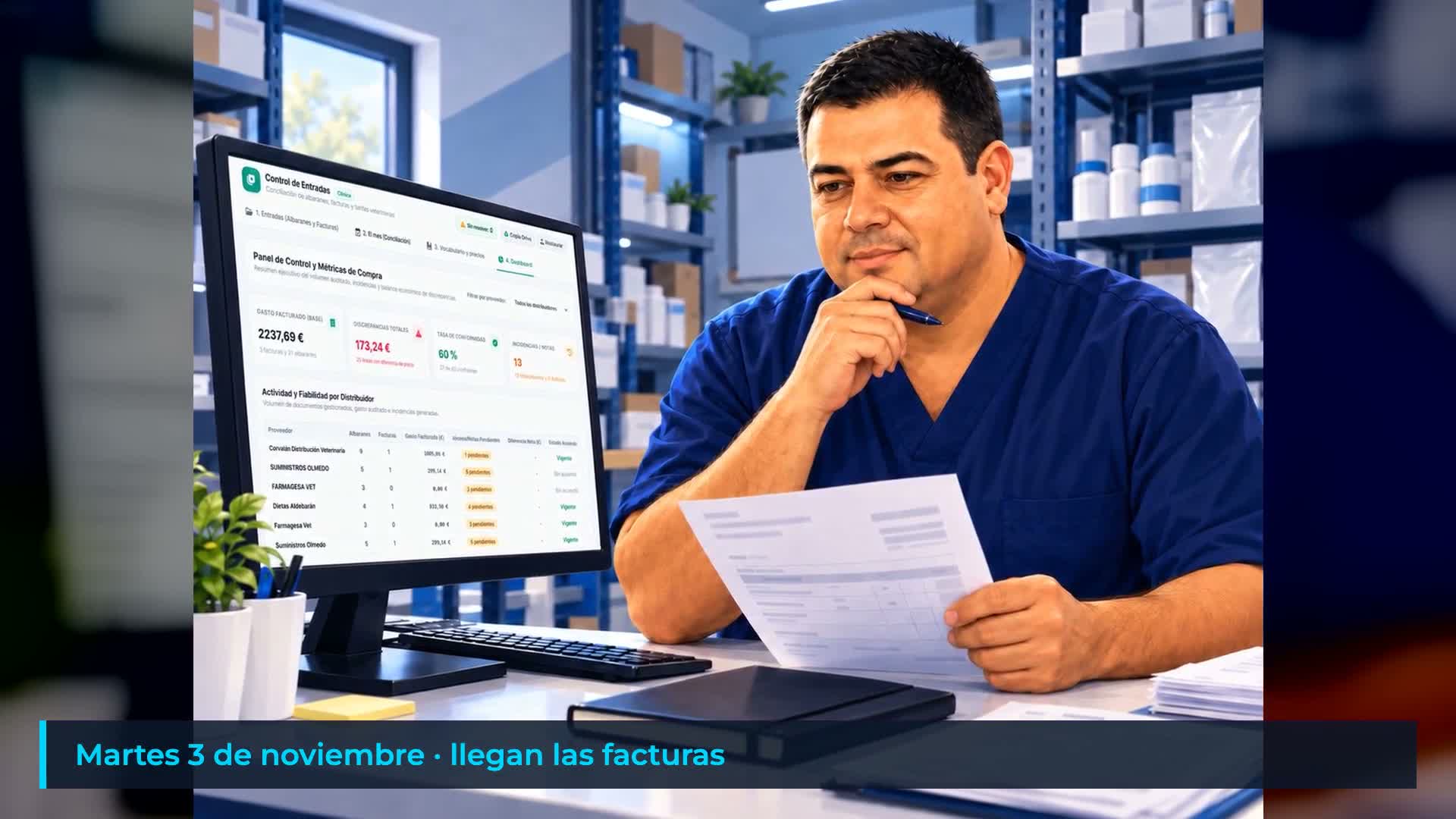
Tuesday, November 3rd. The four invoices arrive. Diego uploads them one by one and, as with the delivery notes, checks what it read before saving them. The invoices carry nobody's handwriting: they read themselves.

And he runs the cross-check, supplier by supplier.
The first thing he looks at isn't what doesn't match. It's the corner of the sheet.
The Corvalán sutures: ten on the invoice, eight in the box. There they are. The Olmedo paper rolls: six invoiced, four received. There they are.
The two from the test. Both, just like him.
You don't ask a new tool to get it right in its first month. You ask it to say the same as you. And when it does, then you look at the rest.
The rest is long. In Corvalán, doesn't match covers more lines than Diego expected, and not all of them are for claiming. One is his signature again, read as a note. Several come in cheaper than his price list, with the warning check the price list, it may be out of date. One is the offer the sales rep made him in September. The rest are what his sheet has said since July: if it comes in cheaper, the old one is his price list. The screen doesn't say any of that is an error. It says there's a difference. What each thing is, he decides, line by line, and what he decides stays saved for next month.
At the very top, among the pending Corvalán items, is the syringes credit. Thirty-one forty. The note was his, from October 2nd, from the sheet of paper at the bottom of the corkboard. Other months he finds it at the end, when he has reached the bottom of the corkboard and already been an hour with the calculator. Today it was saved from day one.
In Aldebarán, two Urinary cans at twenty-nine forty each: the box price. The can works out at two forty-five. Like in August. That one takes no thinking.
And in the pile that can't be hidden, the October 2nd metronidazole.
Diego gets up, goes to the corkboard, finds the Farmagesa paper and looks at it head-on, in the corridor light. The printed figure, faded, can be read: it's a six. His is too. The invoice charges six. He marks it, and the counter drops to zero for the first time in eleven days.
It wasn't ten minutes. It's the first month, and between showing it the house and deciding what each thing is, it took him longer than he thought. But it was deciding, not copying. And next month the screen already knows what a Corvalán offer is.
In that pile there are four more that Diego finds that Tuesday. We're not telling you what they are: the month's papers are at the bottom of the pill, and Diego's sheet tells you where to look.
5 · The fine-tuning
Under every cross-check there's an email already written: three lines, the figures and a question. Diego reads them with the coffee from Wednesday morning's handover.
He leaves the Aldebarán one as it is.
The Corvalán one, no. It carries everything that doesn't match, including what Diego has already decided not to claim. He removes it: what comes in cheaper doesn't get claimed, it gets asked about. He leaves the sutures and the credit, and adds two lines of his own. One: Could you send us the price list you have in force? Ours is January's. The other: And with the delivery note from the 12th, two chlorhexidines arrived that you haven't invoiced us for.
Marta, reading over his shoulder, raises her eyebrows.
—You tell them that too?
—If I claim what's theirs, I say what's mine. I'll be seeing them on Thursday.
It's what he did in August with the box of serum, and it's on the sheet.
He doesn't touch the price list by hand. Which one is right is decided by the supplier, in writing, and when the new Excel arrives he'll load it with the button.
Marta looks at the screen a while longer.
—And why doesn't the program do this?
—Because the program doesn't let you take orders out. That's why the photos.
Marta notes it in her diary, below two other things. That one she'll ask the software people.
—Send me the link.
—I'll send it. But nothing leaves here: whoever has it sees everything, prices included.
Hugo passes behind them with his coffee and looks at the three piles.
—And the course?
—Fine —says Diego—. Thanks.
On Thursday Corvalán arrives. Diego opens the box, counts, checks the lot numbers, makes his tally marks, signs, photographs it, checks the table and pins the paper up. The notebook is on the shelf, closed. Next to the corkboard, pinned with a drawing pin, the sheet. If one day this has to be done at scale, with more people and years of papers in it, nobody will start from the screen. They'll start from there.
Roble gets inside the empty box before it can be folded up.

The practice, step by step
A · The work order sheet
From the notebook to the sheet and from the sheet to the work order: what you give it, what has to come out, what it must never do, where things are stored and what you don't want. The technique has a name; here it is called a work order sheet.
 8:55
8:55Transcript · A · The work order sheet
At El Roble, 23 boxes come in every month from 4 suppliers. Diego counts them, notes them in a notebook and on the 3rd cross-checks the invoice, the price list and each supplier's agreement. Nothing gets past him. It takes him 3 hours and 40 minutes a month. Opening the box, counting, checking batches and expiry dates is Diego's job and it's going to stay that way.
What can be taken off his hands is what comes afterwards. Copying, cross-checking and the calculator. I need a screen to keep track of what comes in from suppliers. Hugo asked it just like that, in one sentence, and it answered well: a couple of screens, a form and a workflow,
but look how it ends. It asks: which environment are you planning to build it in? And it offers options. About price lists, supplier agreements, credit notes, not a single word. Nobody had told it. He asked how it would be done and it explained, but as for building, it hasn't built him anything.
In this pill we're going to talk about not just asking for it, but also how to brief it. Well, Diego, as he's about to start, picks up his notebook, reads, takes a sheet and starts writing down what has happened. So on one side, he notes down that in April there's a duplicated
line; in May, well, the same product has two different names and it takes half an hour to sort it out. In June some shipping charges shouldn't have applied under the price list or their supplier agreement. In July, well, there's a special price that they haven't applied. In August there's a problem with
units: they've charged for two tins as boxes. In August, well, it says: box of saline they don't charge us for. He notes it down. There are differences between what, between what they send and what is received, or what is ordered and received. And in September they've promised him a credit note for some syringes that arrived broken and damaged.
So what Diego does is translate directly what happened to him into things the application has to do. The next thing Diego does to keep building this context is, well, analyse what else he'd like to include in the tool. I give it a photo of the delivery note with my marks, plus the invoice in PDF.
In other words, I give it the documentation, okay? I also have price lists in Excel, hundreds of lines which also change. I also want a button with which I can somehow replace the prices and so on. On the 3rd, when he reconciles against invoices, he wants a result in three piles: matches, doesn't match,
and not sure, always visible, and that it shows him the doubts so he can clear them up. He also considers having it count the boxes, but thinks no, better to do that himself. He also thinks: that it sends the email to the sales rep for me. Well, instead of sending it, he decides it should leave it written. He sends it.
That it reads his handwriting, all the notes he makes; whatever it can't read, it shouldn't make up. Set it aside, where it can be seen, put it aside. And he tells it to still be there tomorrow. That is, he decides he's going to do it with the clinic's account, not with his own tool that he's been learning with. He also considers what he doesn't want to do.
Nothing to install, no new account, nothing more to pay. We already have Gemini, and if it can't be done, it should tell him, right? Not send him somewhere else to go doing more stuff. Maybe this box of what I don't want is one of the most important things, because if we don't pin it down, it's very likely that the AI will try
to use its whole catalogue, and sort of suggest using other tools, like what happened to Hugo. And here in the corner he's also added how to know if he can trust it. So he writes down a couple of things he knows, so that later, when he checks, if it doesn't detect them, he'll know he can't trust it,
or confirm that he can. So, well, the next thing he'll do is organise these ideas to give it instructions that are much more structured. So Diego will sort things out, just as he sorts the boxes. To each note he gives a number from 1 to 5. So, well, first, the things it has to
check: he writes number 2 on them. So what he'll achieve is to create a clean work order, telling it what he gives it, what must come out, what it must never do, where it's stored, what will happen tomorrow, what he doesn't want, and also the test he's going to run.
And this part, although it looks like manual work we could do any old way, on the fly and so on, really is the essence of the pill. It's really what makes the difference between getting an application the way we want it, and building a Frankenstein out of things we keep changing.
This actually has a name: spec-driven development. It's how programmers work when using artificial intelligence, although here we'll call it a work order sheet. Diego will use it to develop his own tool to save time. Well, Diego, once he has the work order clear, is going to move on to
working in Gemini, as we'd seen. He's decided on Gemini because, well, as a precaution, if he's ever away, has to leave the clinic or whatever, the tool always stays here. And, well, he'll use a part called Canvas, which is here. He has to select it and now we'll see how it creates the plan. Here you choose whether it saves your activity, chats and so on,
and whether to delete them at a certain frequency, and whether to train models with your conversations. Keep it in mind for data privacy and so on, especially when you're going to use it. So the work order is the sheet we've seen, written up clean, with the same sections. Notice that it doesn't include a price. I won't
go through the whole prompt; you'll have it in the pill itself. But you'll see that at no point will I give a price, only the rules for how it has to calculate them. If there are special prices, it will use the special price, otherwise the price list with the product-family discount from the supplier agreements.
I didn't want to put the numbers here. I've asked it to make a section where I can load price lists and agreements, so if the agreements or suppliers change at some point, we can keep using the tool. So let's fire it off and see what comes out.
B · Show it the house
The screen is up in three minutes, on the clinic's account, without asking anything. Before saving, it shows you what it read: agreements, price lists and the first delivery notes, with their doubts.
 7:48
7:48In B the tool's doubts are kept exactly as they happened: the signature read as a note, the possible-duplicate warning, the "Apoquel" the price list doesn't know and the handwritten figure flagged as unresolved for eleven days. The clinic's paid-account label (Google AI Pro, October 2026) shows in the video: what is used is the clinic's account, not a personal one.
Transcript · B · Show it the house
Well, after just a few minutes, around two or three minutes, we've got an app. What you'll actually see is the app with several extra steps, improved, let's say, or with small fixes to problems or workflows, which is what you need to refine when making the lesson, or, well, when making, sorry, the tool. The thing is, otherwise the lesson would get very long. So, well, basically it hasn't asked us any questions, okay?
Okay. I've uploaded several delivery notes. I'll upload the last one. And here it flags a possible duplicate. Okay. I discard it because it's a duplicate. I already have it.
And let's upload some with issues. I've saved them here. This one from Corvalán. Let's look at it too, if you like. This Corvalán delivery was missing 2 units of suture material. And there was also a pending credit note for broken syringes. As you can see, the note appears. And it shows that 2 are missing. So it has detected everything correctly. We save it.
Let's move to the next one. This one from Farmagesa. Let's open it. This is Farmagesa. It wasn't very clear there. I don't know if that's a 6 or an 8. It read it as a 6. Well, it could be. We'd have to go and check. Perhaps if it hadn't seen it clearly, it might have flagged it for us. Here it also says some were missing... Oh, look. Yes, sorry. What it says here is that there's a handwritten 8. We're unsure. It's unsure what it says. Let's see what it lets us do. We delete this here. Will it let us save? Yes, it will. It lets us save it. Okay.
What else? We upload the next one, from Olmedo. You'll all be able to see this. Okay. Here we've marked that only 4 arrived. As you can see, the formats differ. Yet it can still read it. Here, he received 4. Only 4.
And look, on this Farmagesa one, for example, it says the delivery note mentions generic Apoquel from the supplier. And we need to find what it might correspond to in our list. So let's search. We could look for Apoquel, but nothing comes up. We could search by active ingredient. There it is. And we have 5.4 milligrams and 20 tablets. Well, it's the same as this one. Okay, yes, it's the same.
Well, we'd simply open it. Here's our incoming deliveries tracker, with any little alerts that are still unresolved.
Well, using it would be quite straightforward. First, we'd upload the supplier agreements one by one. It analyses them for us. All this use of AI takes place directly inside the Gemini app. And it reads everything directly, and so on. That uses up your subscription allowance. Bear that in mind too. That's why I don't recommend using it with free accounts, because their limits are much lower and they have many more restrictions than a paid account. Here we're using a 22-euro-a-month account, which gives us quite a lot of scope.
We come here to the agreements, Aldebarán, and we're going to do the following. We're going to... I think you can see it clearly. And we'll open this like this so we can see both at once. Here are the terms of our supplier agreement. Okay. Here are our discounts by product family: 12% on dry food, 15% on wet food and 10% on puppy diets. Which is what it has recorded for us. We also have a special price for one specific product, one product code. We have 14.60, and then here are the terms, where it says free shipping for orders over 120 euros. Before tax. Well, here it is. Well, everything is correct. We save it.
Okay, here are the four suppliers registered at our clinic. Dietas Aldebarán, Corvalán Distribución Veterinaria, Farmagesa Vet and Suministros Olmedo.
Okay, we go to the price lists and we'd add them in the same way.
We're on Aldebarán, so, Aldebarán. It shows our fields, and in our fields it suggests what to map from the contents of the CSV. Well, the reference: the product code or reference. Under description or name, we have the product. For family, we can map the range. Unit of measure: the format. We also have the unit price, price per unit and price per box. Here's a preview that gives us an idea of what we'll see. And see here: units of measure, units per box. Unit of measure is the format. We save it. And it loads all the products.
Well, we've now loaded all the price lists. We have 837 product codes saved here.
And, well, what it says is Dietas Aldebarán. Let's look at it too, if you like. This would be the image. Diego received a small delivery note listing the items. He's checked them. And he's signed it and added the date. Excellent. Here it is. You can see there are three lines. The LDR Junior, the Obesity and the Urinary. They're 3 kilos, 6 kilos and a 400-gram tin. Very good. The quantities are 2, 10 and 2. Our count matches. That's what arrived. We also have batch tracking. There's also a best-before date, which it has recorded too. We have no notes to add. And here it left us a note in a field actually meant for issues, not for this. So, if you like, we delete it. And validate it.
C · Day 3
The four monthly invoices arrive. First the corner of the sheet; then, line by line, what is an error, what is a difference and what Diego decides.
 8:36
8:36In C, "doesn't match" is not the same as "claim it": what comes in cheaper gets asked about, and what Diego decides line by line stays saved for next month. In the first month you don't ask the tool to be right: you ask it to say the same as you.
Transcript · C · Day 3
We'd add them here. We'd go to the materials, to invoices. We add the first one. It's analysing it. And... We can look at the invoice if you like. But, well, I don't think there's much point. In principle, it should read it quite well, without any problems. Invoices are usually documents without handwritten notes or anything. If you like... Look, let's open it if you like, but I doubt it has... Let's see. Materials. Invoices. If it had a note, naturally it would be able to read that too. Let's look quickly. Here it is, with its VAT. Whether there's a discount or not, the taxable amount. There are no notes from Diego, so that's it.
So, well, as a prototype I think it's a very good idea for clarifying what you want to do and doing it very quickly. And from here, when you start growing and start to... Well, you use it this month, next month you give it a serious try, and perhaps you can already see the time saved. That's when developing a real app will actually provide you with a solution, in another kind of... of tool that lets you really work on development. We'll cover that in later lessons so you can develop your own tools.
Above all, remember to work through your ideas beforehand. Also remember to define the workflows. It's very important. Because most of what you haven't seen involved things getting stuck, that weren't... Well, the supplier wasn't syncing with its price list. Little things you can look at later, but with these kinds of models, the more thoroughly you work things out beforehand, the better.
Here in the month view, when we had the... the emails, well, it's a way of copying the text, and you can edit it, right? Diego won't send it as it is. Perhaps he wants to add something, or a note is missing, or something else. Well, he can do that manually. And that's the manual adjustment you always need to make with... with AI. On the other hand, in some of these, we've seen quite a lot of differences in... in prices, right? Well, in some cases it's not worth sending this email, and what's needed is to request a new price list. So we simply... simply request it, and we can update it. We come here and update the price list, and that's it.
Okay, that's all. That's it for today's video. And see you next week.
We choose the supplier. Let's start with Corvalán and its invoice. Okay. With Corvalán, it could check everything. Then we have the things that don't match. Here's a list of several lines with things that don't match. We'd need to check them. Look down here, for example. Marginal text. Received in good order. These two, for example: it's a signature. Ignore the note. And the same here. We ignore it.
Okay. Also, Diego, if you remember, had noted in the corner of his sheet that he'd check the sutures and paper. So, well, he comes here. He knows Corvalán supplies his sutures. And he looks for what's happening with the sutures. Here it is. He knows there was an issue with the sutures, detected here: a price issue. Okay. You can see it here. It detects a series of more persistent issues with suture prices. And the paper comes from Suministros Olmedo. We can search for it. Here it is. Examination couch paper roll. Okay, the same thing. They had overcharged him. Well, as he can see, his notes match, as does the way of checking the information he had. The aim for this first month, let's say, isn't to ask it to get absolutely everything right. Because some things, well, will be aspects of the tool's logic that need refining. What we want is for it to at least identify what we do, or something more.
Okay, let's move to the next parameter. Right. We've been billed for two units at 28.75, and we have two units at 31.94. The price is below the price list. Check the price list: it may be old or outdated. Okay. Well, here we'd be losing 6.38. We could check whether there's a problem, or accept the difference. If the difference is accepted, it's approved or tolerated. Otherwise, it simply goes under things that don't match.
And what we've achieved here is getting it to generate text with the full review. We've reviewed the invoice and found a total net difference of 89, okay, against us. And here we break it down for them, with the reasons.
Dietas Aldebarán? Well, the same thing. Matches, doesn't match. Well, in this case there's... Here, a lower price. And the invoiced price is zero agreed. That's because they've billed us for two tins, two tins at 29.40. And this doesn't make sense. It was probably two units. They've made a mistake. And instead of sending us two boxes, which is what we'd ordered, or two tins... Instead of two tins, they billed us for two boxes. Well, that's an error. We need to raise it.
You see, in this case we had something illegible, or a doubtful piece of data, okay, we could come here, where we'd noted it down, and see what happened. Let's resolve it. Okay. In this case, having resolved it, because we already knew it was a 6, it now accepts it, and that's it. No, it doesn't take it into account. Okay.
If you do this exercise, always remember to make backups. Because it lives in the... in the browser's local storage, you may run into problems when, really, what you're going to do is... make changes that will erase everything you've done. So, if you make a backup, you can restore it later. So, as you can see, I'll make this smaller here, and there are quite a few interactions I've had to modify the app. You simply ask it to update this, fix that, without breaking any other function, and that's it. Here it is working. If that happens, you'd simply come here and click "Restore backup", and that's it.
This tool is available as code. You can also share it directly with a link and send it to your colleagues. And anyone with the link can access it and see the information. Let's say this really, well, looks very appealing, but as it grows, as you can see, it becomes a bit of a hassle. Maybe you forget to make a full backup, you've added lots of files, it all gets erased and you have to start again. Well, these things happen, okay?
This month's challenge
What you have seen is not a loaded demo: it is El Roble's whole October. Twenty-three delivery notes photographed with Diego's marks, four invoices in PDF, each supplier's general price list in Excel and CSV, and the four 2026 agreements. It is all below, ready to download.
Build your screen from your work order sheet and run the month through it. The video and the story show seven findings; the papers contain eleven. Four are not mentioned (one of them shows on the screen, if you look closely) and they are in Diego's sheet:
- July · a special price that was never applied → Corvalán.
- April · the same line, twice → Aldebarán.
- June · shipping charges that don't belong → Olmedo.
- "Also if it's cheaper" · somebody is on an out-of-date price list → Farmagesa.
How to know you got it right: across Corvalán, Aldebarán and Olmedo you should claim €246.40; €21.90 come out in the clinic's favour; and at the end nothing is left unresolved.
If your screen throws up more differences than there are, don't be surprised: the same thing happened to Diego. Check which ones are real; that is the part the screen doesn't do. The solution is in the pack, with a warning: don't open it before you finish.
What you take away
- Before asking the AI for anything, write the work order sheet: what you give it, what has to come out, what it must never do, where things are stored and what you don't want.
- The work order carries rules, not prices: price lists and agreements come in through a button and get updated without touching the screen.
- Before saving, the tool shows you what it read. What it can't read with confidence, it doesn't invent: it sets it aside where you can see it.
- Ask for changes one at a time ("fix this and don't touch anything else") and save a copy before each change.
- In the first month you don't ask it to be right: you ask it to say the same as you. Day 3 stops being copying and becomes deciding.
- Mind privacy: the clinic's account, no real data in the exercise, and check what gets stored from what you upload.
El Roble's month of papers and the challenge: twenty-three delivery notes photographed with Diego's marks, four invoices in PDF, each supplier's price list in Excel and CSV, the four 2026 agreements, Diego's sheet, the HTML tool with its optimised prompt and the completed exercise, flagged, at the end. Spanish-language resources, training material: not a certified accounting system nor an audit; try the tool with the exercise data, export copies and do not enter real data.
ZIP · 57 files · Spanish
The consolidated work order that builds the tool, with the improvements from the takes that were not recorded. Literal text in TXT and a PDF for reading. It is the work order as written after the recording, not the initial prompt.
TXT · PDF
What changed between the first screen and the final version: unrecorded iterations, warnings and the pack's limits (uncertified tool, data in localStorage, CDN libraries and remote analysis).
Video transcript
At El Roble, 23 boxes come in every month from 4 suppliers. Diego counts them, notes them in a notebook and on the 3rd cross-checks the invoice, the price list and each supplier's agreement. Nothing gets past him. It takes him 3 hours and 40 minutes a month. Opening the box, counting, checking batches and expiry dates is Diego's job and it's going to stay that way. What can be taken off his hands is what comes afterwards. Copying, cross-checking and the calculator. I need a screen to keep track of what comes in from suppliers. Hugo asked it just like that, in one sentence, and it answered well: a couple of screens, a form and a workflow, but look how it ends. It asks: which environment are you planning to build it in? And it offers options. About price lists, supplier agreements, credit notes, not a single word. Nobody had told it. He asked how it would be done and it explained, but as for building, it hasn't built him anything. In this pill we're going to talk about not just asking for it, but also how to brief it. Well, Diego, as he's about to start, picks up his notebook, reads, takes a sheet and starts writing down what has happened. So on one side, he notes down that in April there's a duplicated line; in May, well, the same product has two different names and it takes half an hour to sort it out. In June some shipping charges shouldn't have applied under the price list or their supplier agreement. In July, well, there's a special price that they haven't applied. In August there's a problem with units: they've charged for two tins as boxes. In August, well, it says: box of saline they don't charge us for. He notes it down. There are differences between what, between what they send and what is received, or what is ordered and received. And in September they've promised him a credit note for some syringes that arrived broken and damaged. So what Diego does is translate directly what happened to him into things the application has to do. The next thing Diego does to keep building this context is, well, analyse what else he'd like to include in the tool. I give it a photo of the delivery note with my marks, plus the invoice in PDF. In other words, I give it the documentation, okay? I also have price lists in Excel, hundreds of lines which also change. I also want a button with which I can somehow replace the prices and so on. On the 3rd, when he reconciles against invoices, he wants a result in three piles: matches, doesn't match, and not sure, always visible, and that it shows him the doubts so he can clear them up. He also considers having it count the boxes, but thinks no, better to do that himself. He also thinks: that it sends the email to the sales rep for me. Well, instead of sending it, he decides it should leave it written. He sends it. That it reads his handwriting, all the notes he makes; whatever it can't read, it shouldn't make up. Set it aside, where it can be seen, put it aside. And he tells it to still be there tomorrow. That is, he decides he's going to do it with the clinic's account, not with his own tool that he's been learning with. He also considers what he doesn't want to do. Nothing to install, no new account, nothing more to pay. We already have Gemini, and if it can't be done, it should tell him, right? Not send him somewhere else to go doing more stuff. Maybe this box of what I don't want is one of the most important things, because if we don't pin it down, it's very likely that the AI will try to use its whole catalogue, and sort of suggest using other tools, like what happened to Hugo. And here in the corner he's also added how to know if he can trust it. So he writes down a couple of things he knows, so that later, when he checks, if it doesn't detect them, he'll know he can't trust it, or confirm that he can. So, well, the next thing he'll do is organise these ideas to give it instructions that are much more structured. So Diego will sort things out, just as he sorts the boxes. To each note he gives a number from 1 to 5. So, well, first, the things it has to check: he writes number 2 on them. So what he'll achieve is to create a clean work order, telling it what he gives it, what must come out, what it must never do, where it's stored, what will happen tomorrow, what he doesn't want, and also the test he's going to run. And this part, although it looks like manual work we could do any old way, on the fly and so on, really is the essence of the pill. It's really what makes the difference between getting an application the way we want it, and building a Frankenstein out of things we keep changing. This actually has a name: spec-driven development. It's how programmers work when using artificial intelligence, although here we'll call it a work order sheet. Diego will use it to develop his own tool to save time. Well, Diego, once he has the work order clear, is going to move on to working in Gemini, as we'd seen. He's decided on Gemini because, well, as a precaution, if he's ever away, has to leave the clinic or whatever, the tool always stays here. And, well, he'll use a part called Canvas, which is here. He has to select it and now we'll see how it creates the plan. Here you choose whether it saves your activity, chats and so on, and whether to delete them at a certain frequency, and whether to train models with your conversations. Keep it in mind for data privacy and so on, especially when you're going to use it. So the work order is the sheet we've seen, written up clean, with the same sections. Notice that it doesn't include a price. I won't go through the whole prompt; you'll have it in the pill itself. But you'll see that at no point will I give a price, only the rules for how it has to calculate them. If there are special prices, it will use the special price, otherwise the price list with the product-family discount from the supplier agreements. I didn't want to put the numbers here. I've asked it to make a section where I can load price lists and agreements, so if the agreements or suppliers change at some point, we can keep using the tool. So let's fire it off and see what comes out.