
 Phase 1 · Win 10 minutes
Explain it to me as if I knew nothing
Pill 1.7 · Quick win · The dangerous word is the one you think you understand

Read the full story
The scene
Ten past eight on a Wednesday in late October. The clocks changed on Sunday and now, at closing time, the sign on Calle Olmos no longer competes with anything: it is the only thing lit up on the pavement and bathes everything in cyan —the shop window, the worn scales, the photo noticeboard, Roble's back, who by this time has already climbed onto the reception shelf and is watching the street as though it owed him something—. In July, that cyan disappeared into the nine o'clock daylight. Now it rules. It is the only sign El Roble gives that winter has arrived.
Marta tidies up. Diego walks over to the counter with a folder and puts it next to the other two, without ceremony, which is how Diego puts things down.
—The third one —he says—. The people from Valencia. The sales rep came this afternoon, while you were dealing with the caesarean.
Now there are three. The Nordvex one has been there since September, since she asked them for a quote for the upgrade —the obvious choice: fifteen years with them, ever since she bought the machines in 2011 with a loan that took her six years to repay—. The other two are there because one Tuesday this summer, while they were changing the analyser filter for the third time that year, Diego stood looking at the machine with his arms folded and said what he had to say:
—I can't fix this any more. —And then, without looking up—: I'd ask someone else. Even if it's only to find out what's out there.
He said nothing else. He never does. But Marta rang three suppliers the following day, because for fifteen years Diego has always been right about the machines before anyone else.
—And? —she asks now, gesturing at the new folder with her chin.
Diego thinks for a second, arms folded.
—The machine is good. —Pause—. I can't tell you about the paperwork. That's for you to look at.
And he gets back to what he was doing. Diego has the analyser ready every morning, knows what breaks, where and why, and also knows where his responsibility ends. He is not embarrassed to say so.
Behind them, Sara picks up her handbag and remarks, to no one in particular:
—Another person asking about the free blood tests at the place on the promenade. Whether it's genuine.
No one answers. The sentence hangs there and fades with the lights.
Marta puts the three folders in her bag. They weigh more heavily on her than their actual weight. In July, she had already closed one matter with a no —the accountants confirmed that the odd-numbered buildings on Calle Olmos fall within a different census area, that El Roble is outside the priority zone, and that the accessibility grant available to her would be 50%, capped at three thousand euros: less than half the cost of the work—. She did not apply. It took her ten minutes to find out, though, rather than a week. Sometimes winning means quickly finding out that the answer is no.
This is different. This is her laboratory.
The nudge
They have dinner late. Afterwards, Marta clears the table and fans out the three folders, and Carlos, who does not usually involve himself in matters concerning the clinic —that is her territory and he respects it—, sits opposite her without being asked. A five-year contract is no longer just the clinic's concern.
He takes his reading glasses out of his shirt pocket and does what he does with every important document: he lines all three up and slowly leafs through them, from beginning to end, while Marta talks him through them. And after two minutes, he asks the first thing anyone who knows nothing about veterinary medicine would ask.
—How many machines do they provide in each one?
Marta starts counting and stops. One includes two analysers and a computer. Another has two and a computer, but the haematology analyser uses a camera, without liquids. The third lets you choose between two different haematology analysers: one costs six euros per test and the other two euros forty —and the cheaper one, she realises when she reads it carefully, measures three populations instead of five, meaning it is the same as the one she has had since 2011—. They are not even offering her the same thing.
—Right —Carlos says, and carries on turning the pages.
Marta gets up to fetch some water. When she returns, he has his finger on the first folder, the Nordvex one, which has been sitting on this table for a month.
—Listen. Here, on page three. It says that at the end of the contract you can buy the machines for two thousand four hundred euros. —He looks up—. But they're giving them to you.
—Yes. Well, they're loaning them to me.
—Right. —Carlos takes off his glasses and lays them on the document—. So why are they going to sell you for two thousand four hundred euros some machines they're giving you?
Marta opens her mouth, but nothing comes out.
She goes back to page four. To the three words she has read twice this month and carried on reading past both times, because you do not stop at something you already understand. Loan for use. It sounds as though they are giving you the equipment. Giving sounds like a gift.
She pinches the bridge of her nose, her eyes closed for a second too long.
She would never do this with her patients: she would never accept a test result as ‘more or less’ right. So why would she do it with twenty-one pages that tie her down for five years?
—Wait —she says.
She picks up her mobile.
The everyday task
It is not just this phrase. It is the ‘excess and sub-limits’ in the insurance policy she renewed without looking. It is the ‘SLA’ in the practice management software. It is the ‘no minimum term’ that does have one if you read the asterisk. It is the acronym in the report from the specialist to whom you refer a case and which you nod along to because you do not want to ask.
But notice the difference, because it is what determines the outcome. There are words you do not understand —and sooner or later, you look those up—. And there are words you think you understand. You never look those up. And those are precisely the dangerous ones, because no one looks up something they already know in the dictionary.
Loan for use does not frighten you. Commodatum would have made you stop. They mean the same thing. And that is why contracts say loan for use.
There is also a difference in scale that is worth recognising: small matters are dealt with at the clinic, in ten minutes —a notice, a sign, an email—. Big matters —five years, serious money, your own laboratory— are taken home, considered carefully and, if necessary, looked at with someone else. That is how it should be. What is not right is making a half-informed decision because a phrase seemed simple.
Because the cost of not stopping is not the embarrassment of asking —asking costs nothing, especially when you are asking a machine—. The cost is making a decision with only half the facts and not realising it.
The breakthrough
When a word stops you —or when it does not stop you and should—, do not skip it. Stop and ask AI to explain it to you as though you knew nothing. It sounds obvious, but three things turn it into a genuine technique rather than a passing ‘hey, what does this mean?’:
- State your level without embarrassment. ‘I'm not an expert in this. Explain it to me from scratch, in plain language, without jargon or technical terms.’ If you do not say so, it gives you a good answer —correct, complete, with ‘borrower’ and ‘rights in rem’— and you are left exactly where you started. The correct answer and the useful answer are not always the same answer.
- Ask for an everyday example. Connecting something new to something you already know is how you truly understand it. And, as a bonus, it is your way of checking that you have understood: if the comparison makes sense to you, you have got it; if it does not, you have not got it yet, so you ask again. It is a lie detector pointed inwards.
- And the step that separates understanding from deciding. Once you understand it, do not stop there: ask ‘right, now that I understand it, what should I look for? What should I actually compare? What should I ask each supplier?’. That turns the word you have understood into a checklist of what to look at —which is what you needed—.
It works for a loan for use and for everything else: the insurance sub-limit, the software SLA, the acronym in the report. Anywhere someone who knows more than you uses a term you would simply accept.
And the usual limit, which matters more than ever here: AI puts the word into your own language; understanding it is not the same as deciding. Knowing what a loan for use is does not tell you whether it suits your clinic. That depends on how many tests you actually run, how much you value not being tied down, and figures only you have. The machine translates the word for you; you provide the calculation, the judgement and the signature.
 9:58
9:58Audio in Spanish · subtitles in Spanish, English and European Portuguese.
The word in action
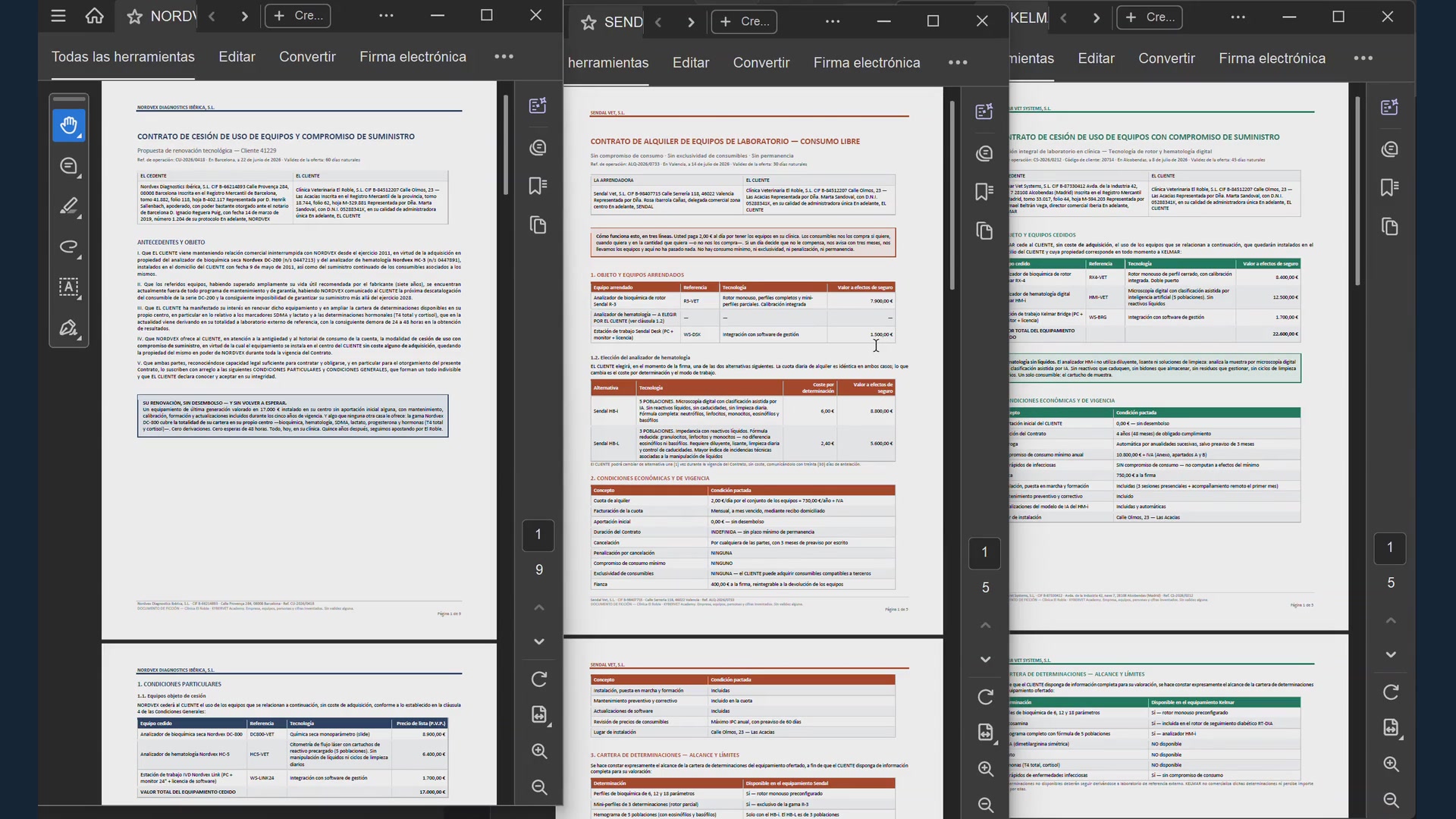
This really happened, in a single chat, with all three contracts uploaded. You can find them below: try it yourself and you will get the same result.
First question, the one we would all ask:
‘I'm uploading three proposals for upgrading my veterinary clinic's laboratory. What are the differences between them?’
And the answer was excellent. One thousand five hundred words. A comparison table, contract models, deposits, minimum terms. It calculated the penalties on its own —‘cancelling in year 3 costs €5,400’, which is correct—. It spotted that the cheaper haematology analyser measures three populations rather than five. It spotted that one of the three is the only one that does not send anything elsewhere. Nine out of ten.
And it does not say once who will own the machines.
In one thousand five hundred words. Not once. The closest it gets is ‘loan for use’, repeated five times and never explained. And this line, which appears in the advantages column:
Option to purchase at the end of the contract for €2,400 + VAT
It did not get anything wrong. It answered exactly what it was asked. It was asked for differences, and it gave differences. The flaw was not in the answer: it was in the question.
Second question:
‘What is a loan for use?’
And the first line, the very first one:
An agreement under which the supplier gives possession of and the right to use equipment, but without transferring ownership. The supplier remains the owner.
There it is. Same documents. Same chat. Same machine. Thirty seconds later. The only thing that changed was the question.
And it added, of its own accord, at the end: ‘it can become a financial trap if your sales fall and you cannot meet the required minimum purchasing levels’. It was not that it did not know. It was that no one had asked.
Third question —the one from this pill—. Because the explanation was correct and abstract: four hundred words containing ‘borrower’, ‘rights in rem’, ‘finance lease’… and not a single example of anything.
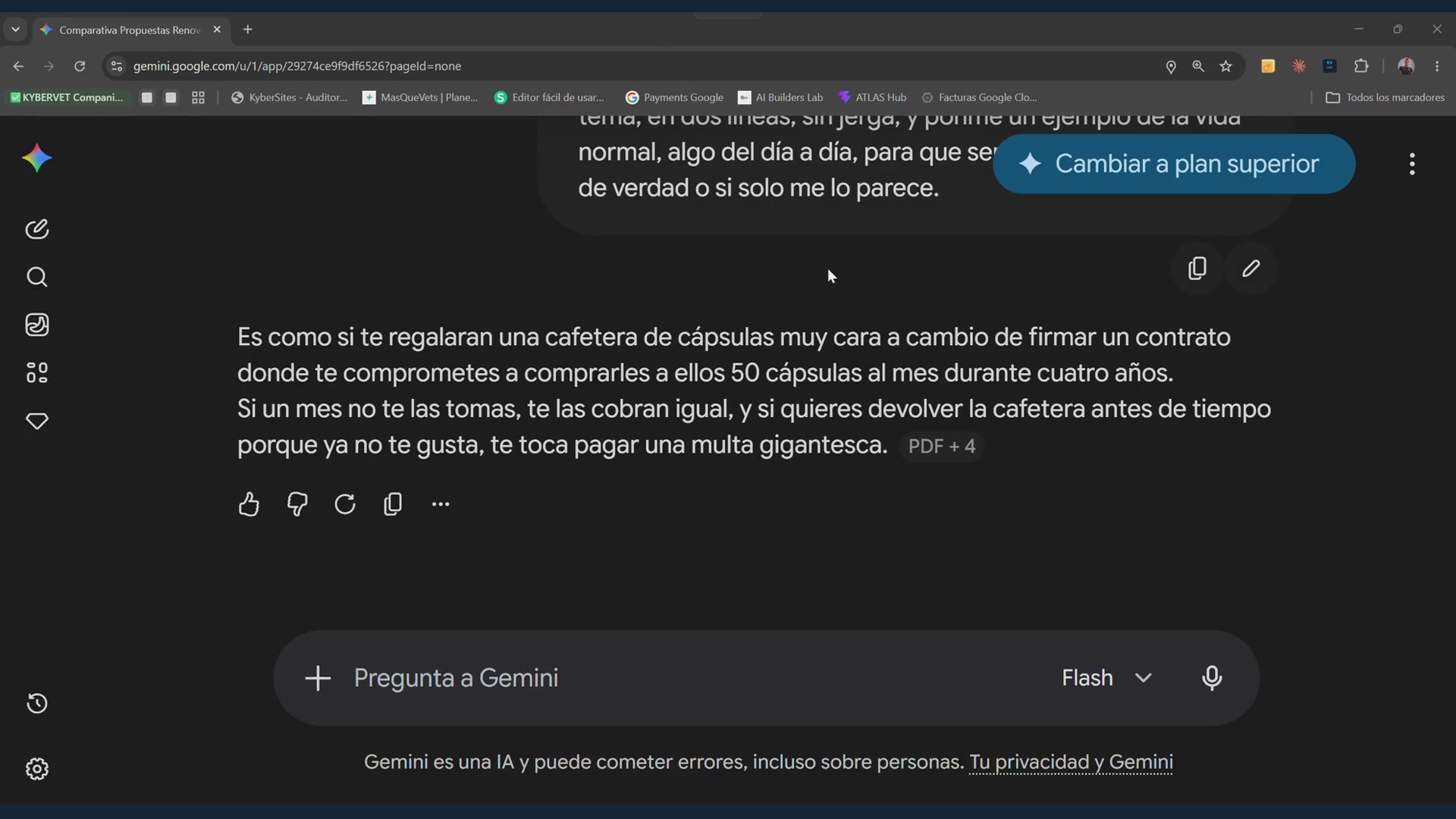
‘Right. Now explain it to me as though I knew nothing about the subject: in two lines, without jargon, and give me an everyday example —something from daily life— so that I can tell whether I have really understood it or merely think I have.’
And this was the answer:
It is as though someone gave you a very expensive capsule coffee machine in exchange for signing a contract in which you promise to buy 50 capsules a month from them for four years. If you do not use them all one month, you are still charged for them. And if you want to return the coffee machine early because you no longer like it, you have to pay a huge penalty.
Two lines. This is what they contain:
| The coffee machine says | The contract says |
|---|---|
| ‘they give you a very expensive coffee machine’ | €17,000 in equipment, €0 upfront |
| ‘to buy from them’ | consumables exclusivity |
| ‘50 capsules a month’ | minimum annual purchases of €15,600 |
| ‘for four years’ | 5-year mandatory term |
| ‘if you do not use them all one month, you are still charged for them’ | clause 6.4 — 50% of the difference |
| ‘a huge penalty’ | €900 per machine for each remaining year |
And here is the important point, because it is easy to overlook: the long answer already said everything. It said ‘the supplier remains the owner’ and it said ‘you will have to pay the difference’. It tells you. The coffee machine makes you see it. And the proof is which of the two makes you get out of your chair to check how many tests you actually run. The example does not explain the contract: it points to the figure you are missing.
And the missing figure. Look at how its previous answer ended: ‘What was your approximate expenditure on reagents over the last year?’.
Approximate. Precisely the word.
So Marta opened her laptop and logged into the clinic's software. She knows where everything is at El Roble except inside that system; Carlos talked her through it —reports, production by area, laboratory, last twelve months, export— and within two minutes they had the document:
‘You asked me for the approximate expenditure. I won't give you an approximation: I'll give you the exact figure. I'm uploading my laboratory production report for the last twelve months. Note: this is not expenditure; it is what I actually do, month by month. The expenditure depends on which of the three I sign. Cross-reference those figures with the prices in the three proposals and tell me how many tests per month I need to run before each one becomes worthwhile.’
42.3 complete tests per month. She had said ‘about forty’. She was not wrong: she was being approximate. And with the exact figure in front of it, the machine performed in twenty seconds the calculation no sales rep was ever going to do for her:
| With her actual volume | Annual cost |
|---|---|
| The no-strings-attached rental | €13,160 |
| The mid-range loan for use | €14,308 |
| The long-standing supplier | €18,192 |
From 53 complete tests per month, the mid-range loan for use starts to become worthwhile. She runs 42. And in twelve months, her best month was 46: she has never reached it.
And two warnings that would not exist without the report in front of it:
1. The 30% discount costs her money. They reduce the rapid test from €9.80 to €6.85 —that part is genuine— in exchange for committing to 30 per month. She does 18. ‘They will charge you for the 12 units you are short.’ She currently pays €2,117 a year; with the commitment, she would pay €2,466. And her best month of the year was 25 tests: it is not merely that she does not reach it on average; she has not reached it once in twelve months.
2. And the minimum, which is not what it seems. Her purchases from the long-standing supplier come to €15,726 — just above €15,600 ‘by the skin of her teeth’, which the machine celebrates. Now subtract the €1,908 for mandatory calibrators, controls and cleaning products. That leaves 13,800. She does not reach the minimum by running tests: she reaches it by buying controls.
And this is where Marta comes in, because the overall calculation was right and the small print was not. Three things, all three on the same, boring line:
- One proposal said ‘controls: €0, included’. Its price list said: ‘Quality control kit (quarterly) — €88.00’. They are not included. That is €352 a year it did not count.
- In another, it divided the price of a quarterly kit by four. €288 too little.
- And in the third, it chose the expensive rotor ‘because the 12-parameter one does not provide comprehensive diagnostics’. No document says that. It made it up. And it did not issue a warning. That is €636 a year, and it shifts the break-even point.
The overall calculation, flawless. The four boring figures, three errors. Which is exactly where the money was hidden.
And the clincher, a textbook example:
‘Rule out the long-standing supplier unless you plan to expand aggressively.’
They asked for a figure and were given a decision about her business. Does Marta plan to expand aggressively? That is not in any of the four PDFs. She knows the answer —the woman who said no four times to a chain that offered her money and would have taken away the clinic's name—.
So she did not sign anything. She went back to all three with three sentences she had not known how to say an hour earlier:
‘I only reach the fifteen-thousand-six-hundred minimum by buying calibrators. Lower it.’ ‘The thirty per cent discount on rapid tests costs me more than the standard price. Either remove the commitment or I will stay on the standard price.’ ‘And if you can terminate whenever you wish without giving a reason, so can I.’
And she sent the accountants three specific clauses instead of twenty-one pages and a ‘have a look and see what you think’.
 13:06
13:06Audio in Spanish · subtitles in Spanish, English and European Portuguese.
Do it yourself in 4 steps
- Open Gemini, ChatGPT or Claude in a new chat, upload the full document and ask whatever open-ended question occurs to you. Upload the document; do not recount it from memory: if you ask from memory, it answers from memory.
- Stop at the word. Not the one you do not understand —you would look that up anyway—: the one you think you understand. And ask about it while stating your level: ‘Explain [the word] to me as though I knew nothing, in two lines, without jargon, and give me an everyday example.’
- Check with the example. If the everyday comparison makes sense to you, you have understood it. If it does not make sense, say so and ask for a different explanation. Do not continue until it does.
- Turn understanding into deciding: ‘Now that I understand it, what should I look for? What should I compare?’. And give it your figures, not approximations. You make the decision.
Marta's tip: keep everything in the same chat. These are not four questions: it is a conversation that becomes increasingly precise, and each question arises from what the previous one taught you. And when the answer gives you a condition along the lines of ‘it suits you if…’, stop: that is a piece of your information it is missing, and it is usually the deciding factor.
The prompt · copy it
1) The plain-language explanation (with the passage that stops you):
I'm not an expert in this, and I do not want to be left merely feeling
that I have understood it. Explain the term ‘[the word]’ to me as though
I knew nothing about the subject: in two lines, in plain language, without
jargon or technical terms (no sections of legislation or laws). Give me
an example or comparison from ordinary life —something from everyday life—
so that I can tell whether I have really understood it or merely think I
have. Use British English.

[paste the sentence or paragraph in which it appears here]
2) The bridge to the decision (to give you a checklist of what to look at, not the decision):
Right, now that I understand it: [your situation in one line]. I am attaching
[the document / documents]. Do not decide for me.

- Create a table comparing only what can genuinely be compared between
  them.
- Flag separately any condition or minimum that assumes something about
  me that may not be true.
- Warn me if two things that appear to be the same are not.
- And tell me what questions I should ask each supplier.

Use only what the documents say. If something is not included or you have
to make an assumption, say so instead of taking it for granted.
3) And the one that actually decides —the one almost no one asks—:
I am attaching my actual figures for the last twelve months. Redo the
comparison using them and tell me the figure at which the answer changes.
Before → Now
Before. Three words that do not even make you stop —because they sound like something they are not— and a five-year decision based on what you thought you understood, not on what you actually understood.
Now. One minute: you stop at the easy word, ask for it to be explained as though you knew nothing, check your understanding with an everyday example and provide your actual figures. For each word, not just for each contract. And the best part is not the explanation: it is that you stop nodding along blindly.

Before you start
- AI explains; understanding is not deciding. Knowing what a word means does not tell you what is right for you: that depends on your figures and your judgement. You provide the calculation and the signature.
- And check the small print, even if the overall calculation is right. Here, the machine calculated three penalties perfectly and made three mistakes with the calibrators and controls. The boring details receive the least attention — and that is where the money was hidden.
- If it gives you a condition along the lines of ‘it suits you if…’, it is missing a piece of your information. Provide it. And if it invents a criterion to choose for you, catch it: here, it chose the expensive reagent ‘because the cheaper one does not provide sufficient coverage’ — and no document said that.
- For a real contract, the explanation is no substitute for an adviser. AI puts it into your own language so that you know what to ask and what to look for —which is already extremely valuable—. But if the document commits you for years and involves serious money, have your accountant or solicitor review it before signing. AI does not review contracts or advise you what to sign.
- Be careful what you upload. A standalone paragraph is not a major issue. If you upload the entire contract, it includes your tax details, prices and signature, and is processed in the cloud. Redact anything unnecessary —we will look in detail later at how to upload documents sensibly.
- Works on free plans (subject to daily usage and file-size limits). Requires an internet connection.