
 Phase 1 · Win 10 minutes
The discharge report that prevents three calls
Pill 1.10 · Quick win · Write nothing new: give AI your material and your structure
Read the full story
The scene
A Thursday in mid-November. One of those days that begins with two emergencies and ends without anyone having sat down.
Káiser came in that morning. An English bulldog, seven years old, twenty-eight kilos when he should weigh twenty-three, with a lump on his left side that had been growing for weeks and that he had already licked until it was raw. Anaesthetising an overweight brachycephalic dog is not like anaesthetising just any dog: his clinical record contains three pages, written over the years, on how to do it. Hugo read every word before starting. General anaesthesia with intubation, a local block, and the whole afternoon under observation during recovery. By twenty past seven, Káiser was awake and on his feet, growling at the Elizabethan collar with the wounded dignity of a bulldog.
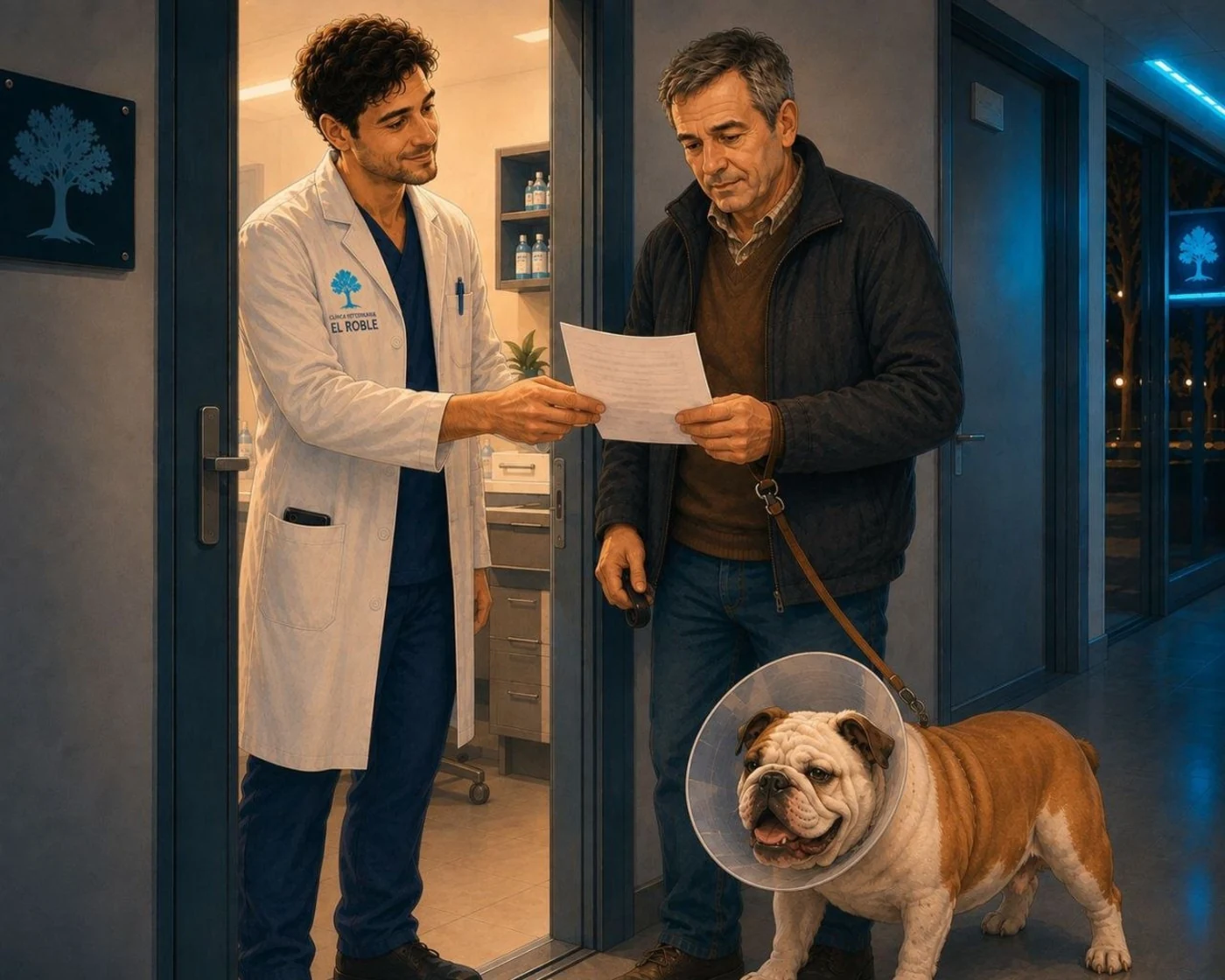
And when Pacheco came to collect him, Hugo did what he had not known how to do a few months earlier —he had learnt the hard way, with a cat with renal disease and owners who left without having understood a thing—. He did not reel off the report in one go. He crouched down to the dog's level, placed a hand on his back and explained everything slowly. He let him ask twice. And Pacheco —Pacheco, the one who sent that email about the invoice, the one who wrote that he was considering taking the dog to the vet on the Paseo— nodded, said ‘well, let me know what you find out about the lump’, and waited by the door while the printout came through.
The practice management system generates the report, and it looks good. The clinic letterhead, the patient's details, the procedure, the medication dispensed, a space for the next appointment. Nothing to fault. Hugo handed it to him, said goodnight and went to close up. It was already dark outside, and the cyan glow from the sign on Calle Olmos reached along the corridor to the door without quite coming in. Roble walked past without looking at him, heading for the shelf. At 20:10, the lights went out.
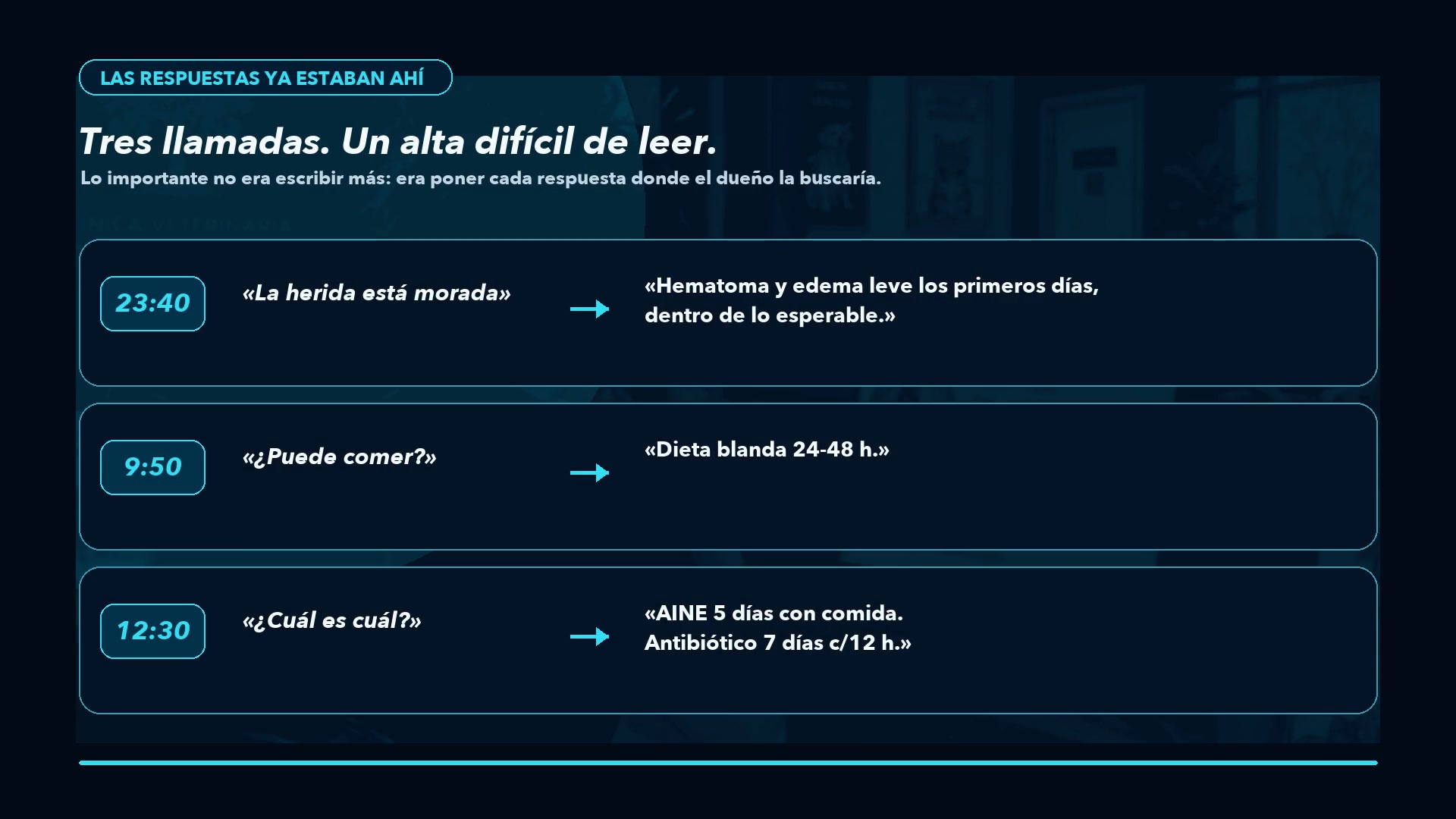
Over the following twenty-four hours, the phone rang three times.
At 23:40 that same night, on the emergency mobile: ‘There’s a hard lump under the wound and it’s purple. Sorry about the time, but I didn’t know whether this was normal.’
At 9:50 on Friday, Sara answered: ‘Can he eat normally? Because he isn’t eating. Should I give him his usual food or something soft?’
And at 12:30, Sara again: ‘Right, the tablets. There’s a white one and a pink one. Which is which? With food?’
And there was a fourth thing, which nobody called to ask about and is therefore the worst of all: Pacheco had taken off the Elizabethan collar on the first night so that he could sleep comfortably.
The nudge
Sara is not angry with Pacheco. She is angry with the sheet of paper.
Because after the third call, she does what she always does when something keeps happening: she picks up Káiser's report, sits down for five minutes and looks. And it is all there. All three things. In the same paragraph.
‘Mild bruising and swelling during the first few days, within the expected range.’ — That was the half-past-eleven call. ‘Soft diet for 24–48 hours.’ — That was the 9:50 call. ‘NSAID for 5 days with food. Antibiotic for 7 days every 12 hours.’ — And that was the 12:30 call.
It was written down. It was well written. And it was no use at all.
When she shows it to Hugo, he does not become defensive either —he has learnt that lesson now—. They look at the paragraph together and see it at the same time: seventy words in a row, written by a veterinary surgeon for a veterinary surgeon and ordered according to the way the clinic thinks —procedure, findings, treatment, follow-up—. At half past eleven at night, with the dog in front of you and the wound turning purple, the answer is in there; but you have to go looking for it. And nobody searches at that time. They call.
Then Sara takes out her to-do sheet and shows him the margin, where she has had five things written down for months. They are not about Káiser: they are the questions that always come in after any discharge, with any dog and any owner.
Whether what they can see in the wound is normal or they need to come in. Whether the dog can eat and what to give them. How and when to give the tablets. How long to keep the collar on. And when they need to come back.
Hugo stares at those five lines for longer than it takes to read them. Because there is the template for a perfect discharge sheet —the exact order in which an owner needs the information— and it is not the veterinary surgeon who has it: reception has it, from answering the same questions over and over again on the phone.
That evening, he tries it. And he does the sensible thing, what anyone would do: if the problem is how it is written, have it write a better one. He opens Gemini and asks for ‘a post-operative discharge sheet for a dog that has had a lump removed’.
What comes back is an excellent template. And it is absolutely no use to him. It takes him two minutes to see why —and the reason is not the one he expected—.
The everyday task
It is not Káiser. It is every discharge, every treatment plan, every set of ‘instructions for home’ that goes out through that door.
And the cost of getting it wrong is not the sheet of paper: it is everything that follows. The calls come through to reception, not to the person who signed the discharge sheet —five minutes each, at the busiest time, with a full waiting room and somebody standing there waiting—. The treatment plan is only partly followed. The collar comes off on the first night. And the owner who does not call is worse than the one who does: they search online, live with the uncertainty or make their own decision.
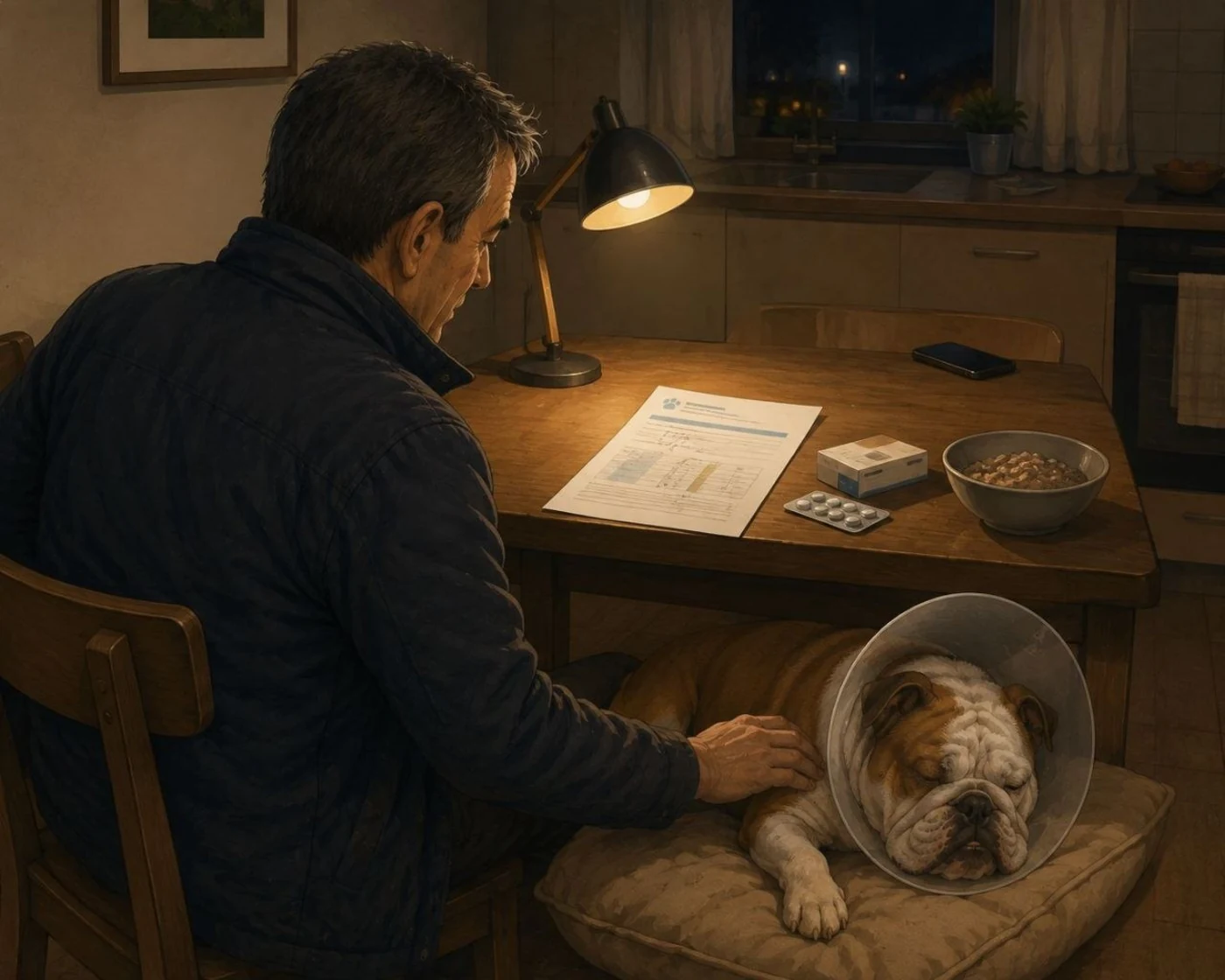
Because the discharge sheet is the only part of your work that stays in their home. You have two minutes with them in the consulting room; that sheet sits on the kitchen table for a week and is read at eleven o'clock at night, with the dog behaving oddly and nobody there to ask. In a neighbourhood veterinary practice, that sheet of paper is the clinic for seven days.
And the trap is that you already know this. Writing it clearly, comprehensively and in plain language takes fifteen minutes per discharge. Fifteen minutes that do not exist at 19:40. So what goes out is whatever the practice management system produces. Not through carelessness: because there is no time.
The breakthrough
In Pill 1.3 we learnt to translate: to say the same thing in different words so the owner can understand it. Today you are not going to translate anything. Today you are going to decide the order — and you are not going to write a single new line.
Because if you ask AI to ‘write me a discharge sheet’, it gives you nobody's discharge sheet: attractive, generic, with a dozen blanks to fill in by hand and —this is the part you do not see coming— half a dozen definite statements that nobody has provided. It does not fail where you are looking. It fails where you are not.
Today's technique divides the task into two halves that almost everyone mixes together: THIS IS WHAT I AM GIVING YOU (your raw material) and THIS IS WHAT I WANT (the output structure, written by you). Three things make it a technique:
At the top, what you already have — and do not write it: copy it. This is where the real time saving lies. There is no need to draft new notes: the observations paragraph already stored by your practice management system is suitable exactly as it is, abbreviations and telegram-style wording included. Copy and paste it without changing a thing. Organising it is precisely the job you are going to ask the AI to do; if you organise it yourself, you have already done the job.
At the bottom, the structure — and you write the structure. This is the whole pill. Do not ask for ‘a discharge sheet’: give it the sections in your own words and in the order in which the owner will need them, not the order in which you think about them. You think in terms of procedure → findings → treatment → follow-up. At half past eleven at night, the owner is looking for two things: whether what they are seeing is normal, and whether they need to call right now. That goes right at the top. El Roble's structure came from the five questions Sara answers on the phone every week: what we have done today · call us now if… · what to expect over the next few days · what to give, how much and when (in a table) · what your pet must NOT do · next appointment. Yours will come from your own questions, which you already know by heart.
Two rules, not one. ‘Use ONLY my information; write anything missing as
[TO BE COMPLETED]and do not make it up’ protects you from the gaps. And ‘do not add any advice, care instructions, appointments or recommendations that I have not given you’ protects you from the filler — which is where things really slip through. One rule without the other is not enough. That[TO BE COMPLETED]in the middle of the page is not a mistake: it is the tool alerting you that a decision is missing —and that decision is yours. (If you already dictate clinical records, you have used this without calling it that.)
And the boundary, which is not a minor detail here: the AI is not writing a discharge sheet; it is reshaping yours. The treatment plan, the dose, how long the collar must stay on and what counts as a warning sign are decided and signed off by the veterinary surgeon before any chat is opened. This has a consequence worth making clear from the outset: this does not fix incomplete notes. It organises what is there. If your report does not say that the dog will be subdued for the first forty-eight hours, the owner's sheet will not say so either. The AI puts it into words; you provide the clinical judgement, the treatment plan and the signature.
 14:57
14:57Recorded live in Gemini using Káiser's case. You see the report generated by the practice management system and the three sentences that answered the three phone calls, buried in a seventy-word paragraph. Then the bare request: it produces an excellent template with twelve blanks… together with a review appointment that nobody mentioned, a surgery declared to have been ‘without complications’ despite the AI not having seen it, and four figures it has conjured up itself. Finally, the technique: the paragraph from the system is pasted exactly as it is, along with Sara's structure and the two rules. The discharge sheet comes out on one side of paper, with five [TO BE COMPLETED] markers in the right places. The machine does not do the final minute.
The discharge sheet in action
This genuinely came out of Gemini, over two attempts. (Using the free version, and it returns it slightly differently each time: it is a draft to refine, not a verdict.)
The first attempt: asking for a template
‘Write me a post-operative discharge sheet for a dog that has had a lump removed.’
It produced a correct, well-organised document. With twelve blanks in square brackets —[Pet's name], [Breed], [Dose], every [X] hours…— all in the right places, which is precisely what reassures you. The problem is what appears around the square brackets, stated as fact:
‘The surgery proceeded without complications and the immediate anaesthetic recovery has been favourable.’ It has invented the outcome of surgery it did not witness. If that is printed as written, the clinic is signing a written statement that nobody has verified.
‘First follow-up examination: 3–5 days after surgery.’ It has invented an appointment. And the owner turns up at the clinic on Monday because it says so on their sheet.
‘Inspect the wound twice daily’ · ‘short walks of 5 to 10 minutes’ · ‘half of the usual portion’ · ‘offer water in small amounts’. Four instructions, complete with figures, that nobody provided. They sound reasonable. That is the problem.
‘Antibiotic (if required)’ — it has decided that it might not be needed after all.
And in the procedure title: ‘Surgical excéresis of a subcutaneous mass’. The correct Spanish spelling is exéresis.
There is no phone number. There is no information on how late they can call: it simply says ‘attend the clinic’. And there is no trace of Káiser —no bulldog, no twenty-eight kilos, no ulcerated nodule—.
And it was not bad luck. The previous time we tried the same thing, it invented other details —a ‘gastroprotectant (optional)’ that nobody had prescribed and wound-care instructions ‘with chlorhexidine or diluted Betadine’ that nobody had ordered— and misspelt the same word in a different way: ‘exégesis’. Two attempts, two different sets of inventions, and both times the technical word in the title was wrong. This is not a one-off error: it is how it works. Ask it for a document without giving it any information, and it has to put something in it.
The second attempt: the two halves
A new chat. At the top, the observations paragraph copied from the practice management system, without changing a comma. At the bottom, Sara's six sections and the two rules. And this is what came out, on one side of paper:
1. WHAT WE HAVE DONE TODAY We have removed a lump from the skin on the left side of the body (left flank), which was ulcerated. The surgery went very well and there were no problems. […] We have sent a sample of the lump to the laboratory for analysis. We will have the result in 7 to 10 days.
2. CALL US NOW IF… Bleeding from the wound · An unpleasant smell from the area · Significant swelling or swelling that is getting worse · He has refused food for more than 24 hours · He is very subdued or listless · He is vomiting.
3. WHAT TO EXPECT OVER THE NEXT FEW DAYS It is completely normal and should not worry you if you notice a small amount of bruising or mild swelling around the area during the first few days. This is to be expected.
4. WHAT TO GIVE, HOW MUCH AND WHEN (table) Anti-inflammatory (NSAID)
[TO BE COMPLETED: product name and dose]· For pain and inflammation · For 5 days[TO BE COMPLETED: time or frequency]· Always with food Antibiotic[TO BE COMPLETED: product name and dose]· For 7 days, every 12 hours ·[TO BE COMPLETED: whether to give with or without food]5. WHAT YOUR PET MUST NOT DO He must not have the Elizabethan collar removed: he must wear it at all times until we remove his sutures. · He must not exercise · He must not be bathed · He must not go up or down stairs.
6. NEXT APPOINTMENT We will remove his sutures in 10 to 12 days
[TO BE COMPLETED: exact appointment date and time].
Five [TO BE COMPLETED] markers. And everything else has disappeared. No invented follow-up three days later, no wound-care regimen, no gastroprotectant, no five-to-ten-minute walks, no half portions. Not because we asked it to remove those things: because we told it not to add anything we had not provided.
Notice two details about the order as well: ‘Call us now if…’ comes second, not fifth. And the Elizabethan collar went under ‘What your pet must NOT do’, which is exactly what it is —a restriction, not a medicine—.
And to achieve all this, nothing new was written. It is the paragraph that was already in the practice management system.
And the refinement that Gemini does not do
- The five decisions, completed by hand. Doses, timings, whether the antibiotic is given with food, and the appointment date. These are neither delegated nor dictated to a chat.
- The subtle additions it has made. Hugo wrote ‘without incident’; the sheet says ‘the surgery went very well’ — it has overstated it. And it has invented both indications: nobody said why the antibiotic was being given, and ‘to prevent or treat infections’ is meaningless. That comes out and the actual reason goes in: because the lump was ulcerated.
- What is unnecessary. ‘At 19:20 he was awake and standing’ belongs in the clinical record, not on a kitchen table. And the technical terms carried over from the notes —(swelling), (anorexia > 24 h), (oedema)— come out: the person reading this does not need to know the veterinary terminology.
- What is missing. It says ‘contact the clinic immediately’. How? Until what time? Add the phone number and opening hours: ‘until 22:00, call the landline; after that, call the emergency mobile’.
- And what is not there because nobody wrote it down. Section 3 talks only about the wound. It does not say that the dog will be subdued and have less appetite for the first forty-eight hours —which accounts for half the calls that come in. Why does it not say that? Because it was not in the practice management system's report. Hugo adds it, and also adds it to his notes so that it is there next time.
And Marta, passing behind him and reading the sheet over his shoulder:
—With this one, don't write ‘soft diet’. Tell him what to give and how much. And don't increase his portion; the dog is already carrying more than enough weight.
So the line becomes: ‘Tonight, give him half a portion of his usual food, moistened with warm water. Tomorrow, give him his normal portion. No treats and no food from your plate: Káiser is already overweight.’
Because ‘a soft diet for a few days’ is no use to Pacheco: he interprets it his own way, and his way means more food. A man who argues about everything and loves that dog to the point of overfeeding him needs a precise instruction without a lecture. Lectures bounce off him; figures he follows. That is not in Káiser's clinical record: it comes from twenty years of knowing the people who walk through that door.
The discharge sheet fitted on one side of paper. And this time, there was no need to return a single call to Pacheco.
What you have already learnt
You are on the tenth pill, and these are no longer ten isolated tricks. Look at what is building up:
- From Pill 1.1, you bring the
[to be completed]marker. You were already using it when dictating the clinical record, without giving it a name. Today it stops being a habit and becomes a written rule in the prompt. - From Pill 1.3, you bring the language; today you add the order. There, we learnt to say the same thing differently so the owner could understand it. Here, you do not translate: you decide what comes first and what comes next. They are two different skills, and you need both.
- From Pill 1.9, you bring the habit of providing your own material. There, you gave it your clinical records so it could identify the pattern. Today, you give it what your system already stores — and you also define the structure.
And you are always going to want this to be the same: the same structure, the same sections, the same two rules. Save the prompt somewhere close at hand. In the next pill, we will stop pasting it.
Do it yourself in 4 steps
- Copy what you already have. Open the discharge report generated by your system and copy the observations section exactly as it is, abbreviations included. Do not tidy it up: that is precisely what you are going to delegate. And before you open anything, decide the treatment plan and what counts as a warning sign yourself.
- Write your structure once. Set out the sections in your own words, in the order in which the owner will need them at eleven o'clock at night. If you do not know what they are, ask reception: the person who answers the phone knows the five questions by heart.
- Combine everything in a single message:
THIS IS WHAT I AM GIVING YOUat the top,THIS IS WHAT I WANTunderneath. Include both rules: anything missing,[TO BE COMPLETED]and do not add anything I have not provided. - Then do your part, which cannot be delegated. Complete the
[TO BE COMPLETED]markers. Remove anything it has added and anything unnecessary. State until what time and by which means the client can contact you. Add anything missing because it was not in your notes —and add it there too, for next time—. Then sign it.
Sara's tip: the person writing the discharge sheet does not have the best structure; the person answering the phone does. For one week, write down what people ask you after every discharge. By the fifth day, no new questions appear: that is your template, and your neighbourhood has written it for you.
The prompt · copy it
You are my assistant for writing discharge sheets for OWNERS, not for
veterinary professionals. You do not make any clinical decisions: I provide
the treatment plan, and you write it in the language and order in which it
will be read by someone at home, at night and worried.

=== THIS IS WHAT I AM GIVING YOU (copied from my practice management system, exactly as it is) ===
[paste the patient details and observations section here,
without organising it or removing any abbreviations]

=== THIS IS WHAT I WANT ===
A discharge sheet that fits on ONE side of paper, with the following sections,
in this order and with these headings:
1. What we have done today
2. Call us now if… (warning signs, at the top and clearly visible)
3. What to expect over the next few days (what is normal and should not cause alarm)
4. What to give, how much and when → IN A TABLE: medicine | what it is for |
   when | with or without food
5. What your pet must NOT do
6. Next appointment

RULES (important):
- Use ONLY my information. For anything I have not provided —doses, dates,
  times, the indication for a medicine— write [TO BE COMPLETED: what is missing].
  Do NOT invent or estimate it.
- Do not add any advice, care instructions, appointments or recommendations
  that I have not provided.
- No jargon: write as though you were explaining it to a neighbour. If my
  notes contain a technical term, translate it and do not leave it in brackets.
- Address the reader directly, use British English, and keep the tone warm and
  straightforward. Avoid stock phrases ("please do not hesitate to contact us").
- Use short sentences. Make sure it fits on one side of paper.
Go one step further: the same material, a different structure
This makes it immediately clear that the structure is in charge, not the material. In the same chat, without pasting anything again:
Perfect. Now give me the SAME discharge sheet, using the same information and
without changing the treatment plan, but in a different structure: for an older
person with poor eyesight who will read it alone. One-line sentences. No tables.
List the medicines one below the other with the time written out ("at 9 in the
morning" instead of "every 12 hours"). Put the phone number first and last.
Same information, same treatment plan, same dog. A completely different document. You have not asked for different content: you have asked for a different structure —and the content has not changed—. Keep both versions. One will work for almost everyone; the other, for Don Ramón and half the clients at a neighbourhood practice.
(And yes: if you ask, it will produce a one-page PDF. But it is nobody's PDF —without your letterhead, your logo or your phone number— and you have to ask for it again each time. We will fix that in the next pill.)
Before → Now
Before. Either fifteen minutes writing the discharge sheet by hand —which you do not have at 19:40— or the report produced by the practice management system: correct, complete and written by a veterinary professional for another veterinary professional. Then, over the following twenty-four hours, three calls that come through to reception and an Elizabethan collar that somebody removes on the first night.
Now. Two minutes, without writing anything new: you copy what your system already stores, provide your structure, complete the [TO BE COMPLETED] markers and sign it. The real benefit is not an attractive sheet of paper: it is that the owner finds the answer at eleven o'clock at night without calling anyone, and the same five questions stop coming in by phone.
Before you start
- AI does not write your discharge sheet: it reshapes yours. You decide and sign off the treatment plan, the dose, how long the collar must stay on and what constitutes a warning sign before opening the chat.
- It does not fix incomplete notes. It organises what is there. If your report does not say that the dog will be subdued for two days, the owner's sheet will not say so either. Whenever you find something missing, add it to your notes as well: next time, it will already be there.
- Watch what it adds: that is how things slip through. If you ask without providing any detail, it will not usually invent the dose —it leaves it in square brackets, looking very proper—; what it invents is everything else: a review appointment nobody arranged, a surgery ‘without complications’ that it did not witness, how many times a day to inspect the wound, how many minutes the dog may walk. And those neatly placed square brackets are exactly what stops you rereading everything else.
- The two rules belong together. ‘Use only my information and mark anything missing’ protects you from the gaps. ‘Do not add anything I have not provided’ protects you from the filler. One rule without the other is not enough.
- It also makes mistakes in your language. In two tests, it wrote ‘excéresis’ and ‘exégesis’ instead of the correct Spanish term ‘exéresis’, and called what had just been removed a ‘little lump’. Read the entire sheet before signing it: the wording is your responsibility too.
- Always check the numbers. Doses, days, dates, times and the phone number. A discharge sheet containing an incorrect detail is worse than having no discharge sheet.
- Replace vague instructions with precise ones whenever you know it matters. Everyone interprets ‘a soft diet for a few days’ differently. The machine cannot make that adjustment: it requires knowing the owner.
- Leave client data out. To write a discharge sheet, you do not need the owner's name, phone number or address: species, weight, what was done and the treatment plan are enough.
- Say how they can contact you and until what time. ‘Call us’ without a phone number or opening hours means ‘you're on your own’.
- Works on free plans (subject to a daily limit). Requires an internet connection.
Practice materials
The two reports used in the demonstration: the original simulated PIMS output and the version reorganised for the owner.
The two reports used in the demonstration: the original simulated PIMS output and the version reorganised for the owner.
Video transcript
Three calls about the same dog in 24 hours, one at 11:30 p.m. to the emergency mobile, and surprisingly, everything had gone well at the clinic. The veterinarian had explained it slowly to the owner, crouching beside the dog and letting them ask twice, and they left understanding everything. This is what they took home. And note that this is not a bad discharge report. It comes from clinic management software, is well presented, and includes everything: the antibiotic, duration, collar, and when the sutures should be removed. It even explains that bruising in the first few days is normal. Everything they asked about by phone is in there—all three points. Yet they called three times. So the first thing anyone would think—and reasonably so—if the problem is how it is written, is to ask AI to improve it or provide a template. So they would normally say something like, "Write a report." For example, let's paste this here: "Write a postoperative discharge report for a dog that had a lump removed." And send it. Well, as you can see, essentially, it gives us... First, it says that this is for information only. It immediately starts warning that it has no professional medical validity, and gives us a sort of template with lots of fields to complete. That is not exactly what we wanted. So here are some of the details. We could fill in the headings and so on, but that makes it more complicated. Yet if we look at it in a little detail, we will probably find some errors. The first is that it invents the outcome of the surgery. What I mean is that, for example, it says: "The surgery proceeded without complications, and immediate recovery from anaesthesia was favourable." Fine, this might work as a template, but it asserts something we do not know to be true or whether it needs changing. That always requires human review. I also noticed here, for instance, it uses "excéresis," which is not a word; it should be "exéresis." And probably because we did not give it any instructions, it also provides, for example, some figures that may seem reasonable, but which we must review: short walks; we should also review "small amounts," "half a ration," and whether follow-up should be after a certain period... It then gives us some warning signs and tells us to visit the clinic, and so on. Naturally, it is not personalised either, and ultimately we have a template we need to review and work on, with blanks to complete. Ultimately, this means more work. The report may be a little longer and more readable for the owner, but it still creates work, so this is not the solution we are looking for. So I think we need something different. The logical next step is to start another conversation—a new chat—and explain what we need. We will dictate it: "You are my assistant for writing discharge reports for owners, not veterinarians. You make no clinical decisions. I give you the care plan, and you write it in the language and order in which a worried person will read it at home at night." "This is what I give you." Stop. Let's phrase it differently. For example, "This is what I give you," then we provide it. This is the technique we want to apply today. We will give it the data from the report generated by our practice management system. So we enter, for example: Káiser, canine, male English Bulldog, aged 7, 28 kilograms. When sharing patient data, we could take a little more care. Perhaps this matters less with animals, as these details are not highly sensitive. Otherwise, we can change or omit the name, provide the rest of the information, and enter the patient's name ourselves. We give it the report text: excision of an ulcerated cutaneous nodule on the left flank; no complications; monitored recovery; awake and standing at 19:20; sample sent to the laboratory, results in 7–10 days; Elizabethan collar at all times until suture removal; NSAID for 5 days with food; antibiotic every 12 hours for 7 days; bland diet for 24–48 hours; rest; no bathing or stairs; mild bruising and oedema during the first few days are expected; suture removal in 10–12 days; review if bleeding, odour, swelling, anorexia lasting more than 24 hours, lethargy, or vomiting. These are quite internal-style instructions that might not help most owners. This would probably cause us problems. But we will tell it: "This is what I want. This is today's technique." So I think we will say, if you agree: "I want a one-page discharge report with these sections, in this order and with these headings: what we did today; call us immediately if...—put the warning signs near the top, where they are easy to see; what to expect over the next few days—what is normal and not alarming; what to give, how much, and when, in a table: medication, what it is for, when to give it, and with or without food; what the patient must not do; and the next appointment." And, as always, let's define what we want more precisely. We will not just state our preferences; we will set some rules. So we will say: "Important rules: use only my data. If I have not provided a dose, date, or time, mark it as pending—that is, say what is missing. Do not invent or estimate it. Do not add advice, care instructions, appointments, or recommendations that I have not provided. Avoid jargon; write as though explaining it to a neighbour. Use informal address and Spanish from Spain, with a warm, direct tone. Avoid formal stock phrases such as 'Please do not hesitate to contact us,' and similar wording. Use only short sentences that fit on one page." Then we submit it and see the result. Fine, it is ready. So let's compare the two. First, it gives us a PDF directly. We can quickly look at what it has produced. Well, it gives us a discharge report. First, it directly explains what we did today in much more everyday language. It gives us a second, more prominent section that immediately tells the owner when they should call us if something happens. So I think that works well. This is very important, because it is what people normally look for when there is a problem of any kind. It explains what to expect over the next few days. It creates a table, which is quite effective in the way it presents the medication, what it is for, when to give it, and whether with food. As you can see, it also flags what is still pending and has not invented anything at all. It lists what the patient must not do and the next appointment. We also left this pending: we will provide the appointment's exact date and time. So it leaves five pending items for us to complete, includes the patient's name, and so on. It gives us a PDF. The issue is that we cannot use this PDF directly. We did not ask for a PDF, but recently, LLMs have begun generating documents to help us. Still, it is not useful to us at this stage. Fortunately, it also generates the same content as text. We can see it here in a preview and could copy it into Word and use it. I think this format is much more useful: it is what we want to give the pet owner so the instructions are clear, including what happened and what Hugo explained. It is laid out far better here than in the template we were creating, which was already difficult to complete. In this case, four or five quick details could be completed in a minute, allowing us to provide a much more useful report than the official report, which I think is more of an internal document. So the main lesson I want you to take from this technique is that we have not written anything new. We simply give it a fairly detailed prompt with the instructions, paste in the text taken directly from the practice management system, and use the same content to generate an instruction sheet that is much more approachable for the owner. Even so, there are, of course, things we could review. I think besides completing everything we have marked as pending, as mentioned, we should check that everything is exactly right. Earlier, for example, I saw: "The surgery went very well, with no problems." It is true that we told it there were "no complications," but this wording overstates it slightly. We could correct that. Another point we could correct, which I saw here: under "antibiotic," it says "to prevent or treat infections." That is accurate—the drug does do that—but perhaps we should explain or clarify that it is because the lump was ulcerated. Or perhaps this note here, which said, "By 19:20, he was awake and standing." Well, perhaps that detail is not relevant—or perhaps it is. Everyone can decide for themselves. And perhaps details such as "swelling" or "anorexia lasting more than 24 hours"... These are all veterinary, clinical, or medical terms. "Oedema," for example, may not be worth explaining to the owner or including at all. Let us not complicate the explanation. But everyone can shape it as they wish. Ultimately, you have a template much better suited to your needs that you can continue refining. And as a preview, I will tell you that in the next lesson we will see how to make the document come out exactly as we want it, including its formatting. And we will use some techniques we have already tried, making it much faster and avoiding this entire exercise, which would probably be rather cumbersome if we wanted to give this report to every client. Obviously, it is much faster than preparing it manually, but it would still take time. And forgive me—I have just noticed another small error here. For example, under "What to expect over the next few days," it says that during the first few days there may be some bruising or a haematoma, which is entirely normal, or mild swelling around the edges of the area. And we had entered—if you remember, you can see it in the system document itself— "bland diet." If we simply write "bland diet," the owner will probably do whatever seems right to them and interpret it in their own way. So perhaps we should add something like: "Tonight, give half their usual portion of food, moistened. Tomorrow, give the normal amount. No treats." So we should include that, which is why it is always important to review whether everything is included. We should see why it failed. But these things happen with AI: sometimes, just as it fills in details, it can also omit them. So there we are. I think the key is, as always, to conclude that AI can help us by doing 80 or 90% of the work, while we use our professional judgement, the guidelines we set, and signature to validate that work. See you next week.