
 Phase 1 · Win 10 minutes
Dictate the record, don't type it
Pill 1.1 · Quick win · Zero installation
Read the full story
The scene
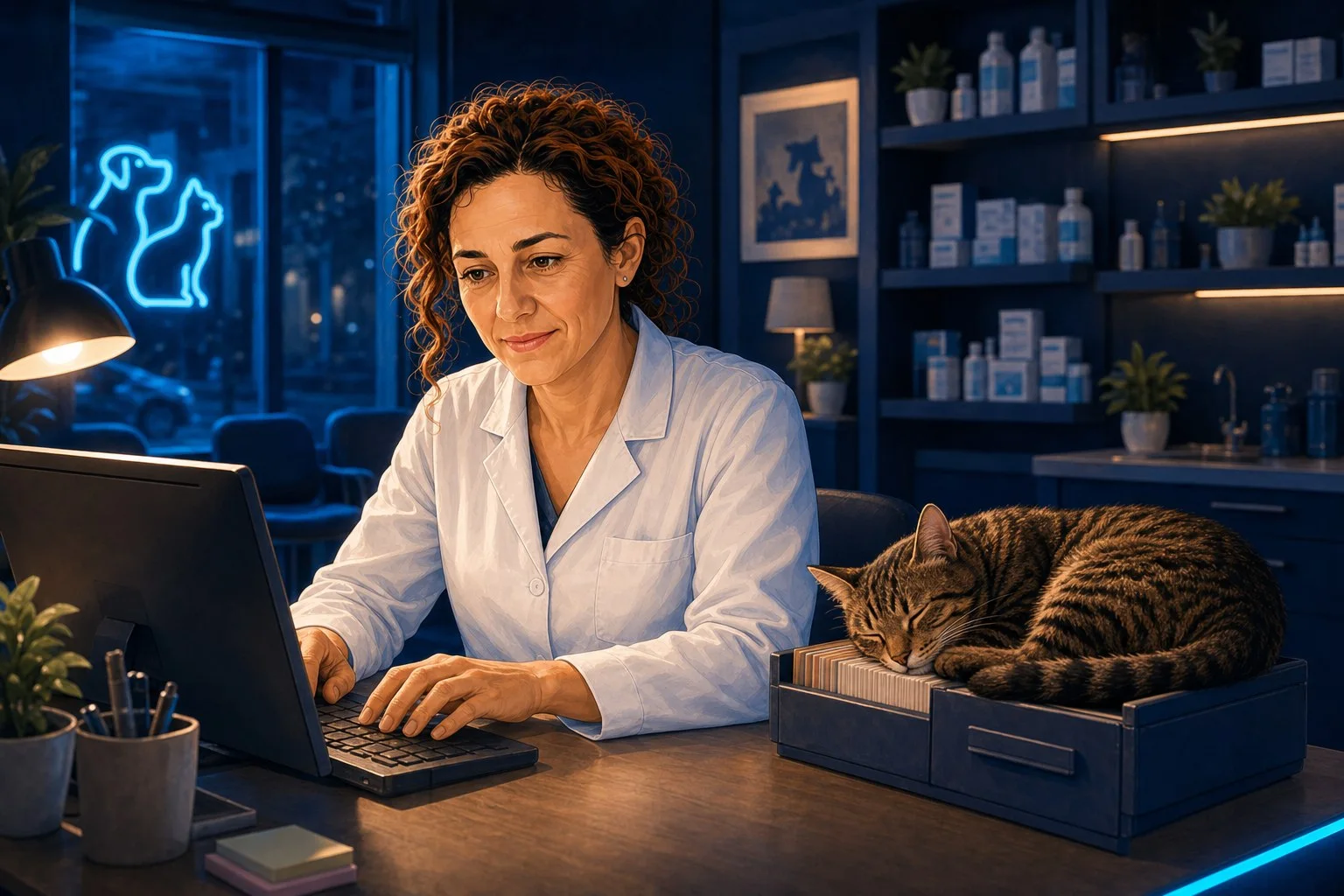
It's 8:10 PM and El Roble now breathes only through the cyan of its sign, which spills in from Olmos street and tints the room blue. Dr. Marta is still at her desk, coat on. Roble, the cat, has settled on top of the box of index cards —like every night she stays too late, as if he knew—. The morning records she closed at midday, eating standing up between appointments; but the afternoon was three hours on her feet, without sitting, without stopping even for the bathroom —six long cases, one after another—, and now, finally in her chair, those six are left half-written. The cursor blinks on the first one: Toby's otitis, Don Ramón's mixed-breed, the five o'clock that ran long. She types with two fingers, slowly, trying to reconstruct what she palpated, what she decided. But the details blur: was it the left ear or the right? She pinches the bridge of her nose, eyes closed a second too long. On her phone, an unanswered message from Carlos: "Should I eat or wait for you?". And Marta does, once again, the same old math: either she stays a long hour to leave them right, or she goes home and finishes them after dinner, or she fills them out fast and half-done —and no, not that, not with her patients—. What she did well in the appointment —listen, examine, decide— now slips away between the keys. And there are still five to go.
The nudge
She's not as alone as she thinks. Hugo, who'd assumed she had left a while ago, is still in the back room sorting tomorrow's supplies; he hears the two-finger typing and looks in. He sees her: coat still on, fingers pinching the bridge of her nose, the stack of cards. Other times he'd have launched into the usual —that there's a faster way, that he'll show her whenever she likes—, and Marta would have brushed him off with a "not now, Hugo". He's learned that with her the speech doesn't land. So he says none of that: he drags over a chair, sits beside her and picks up Toby's card. "Let me. We'll do this fast, I won't even explain it." And they do it together —she talks, telling the otitis out loud as if to a resident; he just holds the phone—. Thirty seconds. The tool hands back the record, ordered: reason, exam, plan. In two minutes the first one is done, ready to copy. Marta says nothing. She looks at the screen, then at the five cards left, then at the screen again. (She'd spent weeks brushing Hugo off about this. Tonight she keeps quiet.)
The everyday task
The real test isn't that night, with Hugo beside her. It's the next day, on her own, between the eleven o'clock appointment and the quarter past. And that's where what no video shows turns up: the friction. It's no magic. The mic catches her talking too fast and a bit has to be redone; an emergency comes in and she leaves it half-finished; the quarter-past is already in the room. The first time it takes almost as long as typing, and she's about to chuck the whole thing. But by the third she's got the hang of it, and by mid-morning she has three records closed that another day she'd have taken home. It's not that the tool is miraculous: it's that, at last, the paperwork fits inside the workday. And Marta notes one thing to herself, almost like one of her own orders: these five minutes —the ones that talking instead of typing gives back to her— must be protected. Blocked in the schedule as if they were a patient. Because otherwise the day eats them, just as it has eaten everything until now.
The unlock
Don't type. Speak. You grab your phone and tell the AI the case like you would a colleague: "Dog, German shepherd, eight years old, presented for…". You tap the mic, talk for thirty seconds, and the AI returns it as a structured record: reason, exam, diagnosis, plan. One tool, one idea: speaking is faster than typing. You still decide everything.
 2:48
2:48Audio in Spanish · subtitles in English, Spanish and Portuguese.
Do it yourself in 4 steps
- Open the AI app on your phone (in the video we use ChatGPT; Gemini or Claude work just as well) and start a new chat.
- Paste the base prompt once and save it.
- Tap the mic and dictate the case like you would a colleague: species, age, reason, exam, diagnosis, plan.
- Review the structured record, correct it and copy it to your practice management software.
Tip: keep the base prompt in your phone's notes so it's always at hand.
The prompt · copy it
You are my assistant for writing veterinary clinical records.
I'm going to dictate a case speaking naturally, out of order.
Turn it into a structured, clear and professional clinical record, with these sections:

- Reason for visit
- Physical examination
- Diagnosis (or presumptive diagnosis)
- Plan / treatment
- Recommendations for the owner

Rules:
- Use only the information I give you. Do not invent data, doses or findings.
- If something important is missing, mark it as "[pending]" instead of filling it in.
- Clinical, concise and readable language. English.
- Do not include owner names or identifiable personal data.

When you're ready, say "go ahead" and I'll start dictating.
Go one step further: make it your GPT
The step above already works today. But if you're going to do this every day, the logical thing is to never paste the prompt again: create a GPT with that prompt already inside. Then you just open your assistant "El Roble Records", tap the mic and dictate.
- In ChatGPT: Explore GPTs → Create.
- Paste the base prompt above as the GPT's instructions.
- Give it a name, save it and pin it at the top so it's one tap away.
The appetizer: the same idea exists in every app —GPT in ChatGPT, Gem in Gemini, Project in Claude—. Building it well gets a whole pill of its own later on; today it's not the point.
Before → Now
10 min typing each record, after hours.
under 3 min: dictate, review, copy. Per patient.
Before you start
Protect the data: no owner names, phone numbers or identifiable data in a generic LLM. Always anonymize.
- The AI is support, it does not replace your judgment. The record is yours: read it before saving.
- Always review what it returns (doses, laterality, exact findings).
- Works on free plans (with a daily usage limit).
- Needs a connection: it's processed in the cloud.
Video transcript · Toby case — dictating the record in ChatGPT
Right, so this is what Marta would do once she's talked with Hugo and he's explained how she could dictate the cases to put them into the record, once the appointment is over, and not waste time afterward. So, basically, we'd have in our notes our master prompt, which we'd select, okay, copy, and head over to ChatGPT, which is the one we'll use. I'm using a free version. I paste the prompt and send it straight away. Once it tells me to go ahead, I can start dictating. To dictate, it's as easy as tapping the microphone. Don't tap the other button next to it, because that's voice mode and it works differently. To dictate we just give it one tap and we can begin. Here goes.
Mixed-breed dog, male, about 12 kilos, 7 years old, comes in because for 3 days he's been scratching and shaking his head, especially the right ear. On examination, the right ear canal is reddened, with dark wax and quite a lot of pain. The rest, normal. I do an otoscopy and the eardrum is intact. My impression is an external otitis on the right. The plan is ear cleaning, drops with antibiotic and corticosteroid for 7 days, a recheck in a week, and keeping the ear from getting wet. We stop, it transcribes. Once it's all there, if you want you can review it, in case there was any slip or stumble.
Then simply, once it's ready, you hit send and you'll see that in no time you have the report: the reason for the visit, with the physical exam, the presumptive diagnosis, the plan that's been set out and the recommendations for the owner. As you've seen, with very little dictation time, we have the report, which we can leave saved right here on the phone, and then we go to the computer, open our ChatGPT and just look, among the chats, for the right one — this one — we copy it and paste it into the record in our management system. And done.